The National Case Law Archive analysis provides clear, structured commentary on key decisions – explaining what the court decided, why it matters, and how it fits within the wider law. Each analysis highlights the legal principles, reasoning, and practical impact, with links to related cases and key terms so you can follow developments across UK jurisdictions with confidence.
The case explores the boundary between political expression and religious manifestation, and how consistently applied workplace-neutrality policies can defeat discrimination and harassment claims.
The UK Supreme Court in Atkins v HMRC and HMRC v HFFX LLP on s.850 and s.687 ITTOIA: deferred partnership remuneration, the source test and Ramsay limits.
The Supreme Court has confirmed that unfair prejudice petitions under section 994 of the Companies Act 2006 are not subject to a statutory limitation period. This analysis examines the Court’s reasoning, the continuing relevance of delay and the wider implications for statutory and insolvency claims.
This decision overrules Cheshire West and rejected the acid test as a complete test for deprivation of liberty. It outlines the restored multifactorial Article 5 approach, including the renewed importance of valid consent, wishes and feelings.
Analysis of Dillon [2026] UKSC 15 in which the Supreme Court narrows Art 2(1) of the Windsor Framework, confines the Charter & reshapes the Legacy Act.
This review examines why X and Y is a landmark, what it changes in practice, and where its ripples may be felt - including in surrogacy, public law work, and the constitutional law of the prerogative.
The Supreme Court’s decision in CCC v Sheffield Teaching Hospitals is one of the most important recent judgments on quantum, not only in clinical negligence, but across serious injury litigation more generally.
At first glance, THG Plc v Zedra Trust Company (Jersey) Ltd looks like a technical limitations appeal. In reality, it is a major statement about the nature of the unfair prejudice jurisdiction itself. By a 4 – 1 majority, the Supreme Court held on 25 February…
Why a modest compensation-order dispute has become an important authority on finality, correction and the true reach of the magistrates’ post-sentence powers.
The Supreme Court held that Tesco could not use dismissal to remove “retained pay”, implying a term preventing termination where it would defeat a core contractual benefit promised as permanent.
In fields as diverse as public law, immigration, environmental planning, consumer finance, and intellectual property, this year’s decisions underline the importance of remaining current with developments that have profound practical implications.
In Veale (and others) v Scottish Power UK Plc, the UK Supreme Court was asked a tight but commercially significant question: where an injured person settles (and thereby discharges the defender’s liability) before developing mesothelioma, can the statutory “mesothelioma exception” still allow the person’s relatives to…
In X v The Lord Advocate, the Supreme Court held the Crown cannot be vicariously liable for delicts allegedly committed by a Scottish sheriff because stage 1 fails: the relationship is not akin to employment. The key driver is constitutional structure - executive "control" is incompatible…
In Evans v NatWest Markets Plc the UK Supreme Court allowed the banks’ appeal and reinstated the specialist tribunal’s refusal to certify Phillip Gywn James Evans’ application for opt-out collective proceedings in a follow-on foreign exchange (FX) damages claim, emphasising the breadth of the Tribunal’s discretionary…
In Providence Building Services Limited v Hexagon Housing Association Limited the UK Supreme Court has resolved a narrow but high-impact question of contractual interpretation in the JCT Design and Build Contract 2016 termination regime: can a contractor terminate under clause 8.9.4 for a repeated “specified default”…
In the recent judgement Lewis-Ranwell v G4S Health Services (UKSC/2024/0040), the Supreme Court held that the illegality defence can bar a negligence claim even where the claimant was found not guilty by reason of insanity for unlawful killings that sit at the centre of the loss…
In Emotional Perception AI Limited v Comptroller General of Patents, Designs and Trade Marks (UKSC/2024/0131) the Supreme Court has reset the UK’s approach to the “computer program … as such” exclusion, overruling the long‑used Aerotel methodology and aligning UK interpretation with the European Patent Office’s reading…
In Dairy UK Ltd v Oatly AB [2026] UKSC 4, the Supreme Court held that Oatly’s trade mark “POST MILK GENERATION” is invalid so far as it covers oat-based foods and drinks, because section 3(4) of the Trade Marks Act 1994 blocks registration where the mark’s…
The Supreme Court has used King Crude Carriers SA v Ridgebury November LLC to settle a long‑running uncertainty: there is no free‑standing English law doctrine by which a contract condition precedent is treated as fulfilled merely because the debtor wrongfully prevented it.
The Supreme Court’s judgment in Jwanczuk affirms judicial restraint, upholding bright-line rules even amid proven disability-related discrimination. It also clarifies precedent for devolved contexts, limiting strict "follow unless compelling reason" principles to tax cases.





![In the matter of X and Y [2026] UKSC 13: the end of the “inherent jurisdiction” myth in adoption law](https://www.lawcases.net/wp-content/uploads/2026/05/judges-gavel-300x200.jpg)







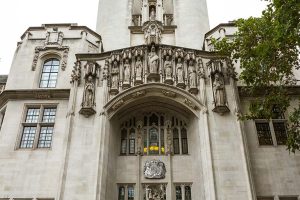





![Illegality, insanity and negligence claims after Lewis‑Ranwell [2026] UKSC 2](https://www.lawcases.net/wp-content/uploads/2026/02/lewis-randell-case-300x200.jpg)
![Patenting AI after Emotional Perception AI [2026] UKSC 3](https://www.lawcases.net/wp-content/uploads/2026/02/emotional-300x200.jpg)

![Debt, damages and prevention of conditions precedent after [2025] UKSC 39](https://www.lawcases.net/wp-content/uploads/2026/02/huge-ships-300x200.jpg)

