

X v The Lord Advocate confirms a hard stage 1 boundary: the Scottish Government is not vicariously liable in delict for a sheriff’s alleged assaults/harassment, even when the conduct is outside “judicial functions”.
Summary:
In X vs the Lord Advocate (UKSC/2024/0116) the UK Supreme Court dismissed the pursuer’s appeal and held that the Crown (sued via the Lord Advocate as representing the Scottish Ministers) is not vicariously liable for delicts allegedly committed by a serving Scottish sheriff.
For practitioners, the judgment has three immediate practical messages.
First, it treats section 2(1)(a) of the Crown Proceedings Act 1947 as a “live” gateway importing the modern common law of vicarious liability (including “akin to employment” relationships), rather than a self-contained statutory code confined to “servants or agents”.
Second, the Court’s stage 1 analysis puts constitutional fundamentals centre-stage. The relationship between the Scottish Government and a sheriff is not “akin to employment”, for two linked reasons: the Government lacks control over judicial functions, and (more importantly) judicial independence (separation of powers) would be undermined if the judiciary were treated as government’s quasi-employees for vicarious-liability purposes.
Third, the judgment narrows the litigation map for claimants harmed by judicial office-holders: vicarious liability against the Crown is a dead end in this fact pattern, even where the alleged wrongdoing is not part of adjudication and so is not caught by the statutory judicial-functions exclusion. The Court did not decide (and we should treat as open) what other viable routes might exist against other entities or on other causes of action.
We should assume this decision will be deployed early and robustly in Scottish litigation where pursuers try to attach “deep pockets” to alleged judicial wrongdoing via vicarious liability, and we should plan our triage, pleadings and risk messaging accordingly.
Case summary
The appeal concerned whether the Crown can be held vicariously liable for delicts allegedly committed by a member of the Scottish judiciary. The pursuer (a legal practitioner; further professional detail is unspecified) complained of four incidents in 2018, alleging assaults in the first three, and (taking all four together) harassment under the Protection from Harassment Act 1997. An anonymity order prevents publication of the appellant’s identity.
At the material time, the alleged wrongdoer (named in the judgment as John Brown) was a sheriff. Following tribunal proceedings under the Courts Reform (Scotland) Act 2014, he was removed from office by the First Minister on 7 June 2024. He was the first defender; the Lord Advocate (sued as representing the Scottish Ministers) was the other defender and respondent in the Supreme Court appeal.
Critically (and this is a point we should keep front-of-mind when advising internal stakeholders), the Supreme Court decided a preliminary issue on pleadings, on the assumption that the alleged delicts were made out. The Court stressed that the allegations were assumed true only for determining the legal issue, and that “[t]he factual question whether the first defender committed the delicts has not been decided” (para 4).
Procedural history and issues
In the Outer House, Lord Clark held that (leaving aside limitation) the vicarious liability claim against the Crown was relevant (not bound to fail) for the first two incidents; he treated a sheriff as a “Crown servant” and considered the relationship with the Crown “akin to employment”. He held the train/FaceTime incidents insufficiently closely connected at stage 2. He also held the assault-based vicarious liability claims time-barred (harassment not time-barred), and concluded the correct law officer was the Lord Advocate (not the Advocate General).
On reclaiming motion, the Inner House allowed the Lord Advocate’s appeal on vicarious liability, holding that judicial office-holders are not Crown servants for these purposes, that section 2(5) did not dictate otherwise, and that the Scottish Government/judiciary relationship is not akin to employment (control and independence). The pursuer’s time-bar appeal fell away, although the Inner House indicated it would otherwise have allowed it.
The issue in the Supreme Court was therefore narrow but important: whether the Inner House was right to conclude that stage 1 of vicarious liability could not be satisfied, so the Crown could not be vicariously liable for the alleged delicts.
Holding
The Supreme Court dismissed the appeal and agreed with the Inner House that the relationship between a sheriff and the Scottish Government is not akin to employment, so there is no vicarious liability at stage 1; “we would dismiss the appeal” (para 64).
Legal analysis
The framework the Court applied
The Court approached the problem through the now-familiar two-stage structure for vicarious liability: stage 1 (relationship of employment or “akin to employment”) and stage 2 (close connection between wrongdoing and authorised activities). Both stages must be satisfied; failure at stage 1 ends the claim.
The key doctrinal move was to insist that this common law structure remains central even when the defendant is “the Crown” and the claim is pleaded under section 2(1)(a) of the Crown Proceedings Act 1947.
Section 2(1)(a) of the 1947 Act is not a self-contained code
The pursuer’s primary argument was that section 2(1)(a) defines the class of persons for whose delicts the Crown is liable (servants/agents), so modern expansions of vicarious liability to “akin to employment” relationships are irrelevant; on that approach, the main contest becomes whether a sheriff is a “Crown servant”.
The Supreme Court rejected that reading. In a sentence that will be quoted back at us in pleadings, the Court said “section 2(1)(a) is not self-contained” (para 51).
Instead, the Court treated section 2(1) as pitched at a general level, aimed at aligning the Crown’s liability with that of “a private person of full age and capacity” across the main categories of tort/delict liability (including vicarious liability). In practical terms, this means the Crown “inherits” the modern common law, including the stage 1 “akin to employment” development, supported by the “always speaking” approach to statutory interpretation.
Two practice points flow from this.
One, for those advising public bodies, section 2(1)(a) should not be treated as a frozen 1947 snapshot: if the common law expands or contracts, the Crown’s exposure tends to move with it (unless the statute clearly blocks the movement).
Two, for claimants, there is no tactical win in arguing “Crown servant” status if the relationship would fail modern stage 1 analysis anyway; the statutory label does not short-cut stage 1.
What “the Crown” meant in this case and who was properly sued
The Court’s discussion of “the Crown” repays careful reading, because it frames the defendant correctly in Scottish litigation and limits the 1947 Act’s reach. The Court treated “the Crown” in the Act as the Sovereign in an official capacity, but emphasised that the Act does not extend across all of the Sovereign’s wide-ranging official capacities; section 40(2)(b) confines liability to that arising in respect of His Majesty’s Government in the United Kingdom or the Scottish Administration.
Within that structure, and consistently with the lower courts, the Supreme Court confirmed that the Lord Advocate was the correct defendant (as the appropriate law officer for proceedings “against any part of the Scottish Administration”), because the relevant manifestation of the Crown here was the Scottish Government as part of the Scottish Administration.
For legal practitioners, this matters even outside judicial-misconduct fact patterns: early mis-joinder arguments (or the failure to spot them) can distort risk assessments, settlement posture, and limitation analysis.
Section 2(5): a limit, but not a gateway
Section 2(5) excludes proceedings against the Crown for acts/omissions done while discharging responsibilities of a judicial nature or in the execution of judicial process. The Court noted there was no dispute that the alleged acts fell outside that exemption.
The important doctrinal point is what the exemption does not do. The Supreme Court rejected the Outer House inference that the existence of section 2(5) implies judges must otherwise be within the Crown’s vicarious-liability net; the Court treated that as a non sequitur.
So, section 2(5) is best seen as a strong “no-liability” rule protecting judicial decision-making, rather than as evidence that judicial office-holders are generally in a vicarious-liability relationship with the Crown.
Stage 1: constitutional principle does the heavy lifting
Having rejected the pursuer’s “self-contained statute” argument, the Court applied the common law stage 1 test: is the relationship between the Scottish Government and a sheriff “akin to employment”?
The Court said no, for two “compelling and linked” reasons: (i) no Scottish Government control over sheriffs’ performance of judicial functions; (ii) the constitutional principle of judicial independence (separation of powers), including the need for freedom from actual or feared executive interference, even in cases where government is a party.
The judgment contains one of those lines that should go straight into our internal briefing notes: “the Scottish Government can tell a sheriff neither what to do nor how to do it” (para 60).
The Court acknowledged that the Scottish Government funds remuneration and has appointment/removal roles, but held that does not change the fundamental character of the relationship. In short: because of the constitutionally required separation, it is “not akin to an employment relationship” (para 61), and the Court agreed with the Inner House that it is “not akin to employment so that there can be no vicarious liability of the Crown at stage 1” (para 63).
Practical implications for legal practitioners
Claims arising from alleged judicial misconduct in Scotland
If we are advising on a potential claim where the alleged wrongdoer is a Scottish judicial office-holder (for example, a sheriff) and the intended deep-pocket defendant is the Scottish Government via the Lord Advocate, this decision materially reshapes the viability assessment. The Supreme Court’s reasoning is not a fact-sensitive balancing of multiple employment-like factors; it is a principled conclusion that the constitutional “shape” of the relationship is not quasi-employment. That means vicarious liability pleadings are likely to be met with early strike-out/irrelevancy challenges on stage 1.
We should also be careful not to overread the “outside judicial functions” point. The Court accepted that the alleged acts were outside the section 2(5) exemption, but still rejected Crown vicarious liability because stage 1 failed. So, even where the misconduct is plainly outside adjudication, vicarious liability against the Crown does not follow.
Wider vicarious-liability work involving public bodies
The decision is not only about judges. It gives a clear steer on how to argue section 2(1)(a) generally: it is a statutory mechanism that places the Crown in the position of a private person, importing modern vicarious liability doctrine rather than preserving a special, narrower, Crown-only scheme. That approach can cut both ways depending on whether we are claimant-side or defending a public body.
In-house (and procurement) teams should take note because “employment-like” risk can arise even without a contract of employment. Where relationships sit between employment and genuine independent contracting, vicarious liability exposure depends on the modern stage 1 enquiry, not purely on labels. This judgment reinforces that the court will look hard at features such as control and constitutional/statutory architecture, not just who pays or appoints.
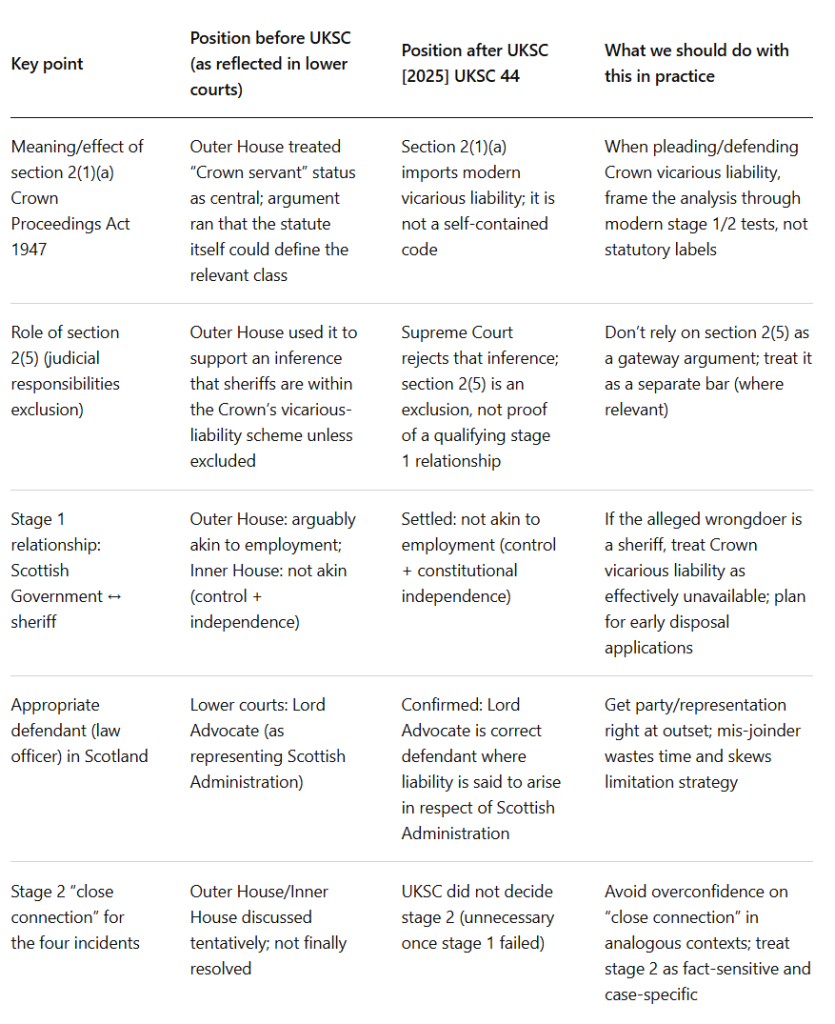
Table of key shifts pre- and post-judgment
The table below summarises the practical movement from the Outer House/Inner House positions to the Supreme Court’s settled position. It is derived from the Supreme Court’s account of the lower court decisions and its own holdings.
Practitioner checklist and next steps
Immediate next steps for teams
If we are advising on a live or threatened dispute in which a pursuer is considering (or has issued) a vicarious liability claim against the Crown arising from alleged wrongdoing by a Scottish judicial office-holder, we should take the following steps.
- Identify precisely what cause(s) of action are pleaded and whether the Crown claim is exclusively vicarious liability (as opposed to any direct-liability theory; direct liability is not addressed in the judgment and should be treated as unspecified for present purposes).
- Confirm whether the alleged acts are said to be within “responsibilities of a judicial nature” or “execution of judicial process” (if yes, section 2(5) is a separate bar; if no, stage 1 may still fail for judicial office-holders).
- Where the alleged wrongdoer is a sheriff, treat stage 1 as the critical point and consider early disposal: relevancy/strike-out, summary decree, or an equivalent procedural route depending on the forum and procedural posture.
- Review limitation positions carefully. The Supreme Court did not decide limitation due to the stage 1 outcome; the Inner House indicated it would have allowed the pursuer’s time-bar appeal if vicarious liability had survived. We cannot treat limitation as “safe” from this judgment.
- Align communications and safeguarding processes: the judgment is about legal liability, not workplace wellbeing. Our staff who appear in court (or engage with judicial office-holders) still need clear internal reporting channels and support procedures (the judgment refers to a complaint to the Judicial Office, which is a reminder that reporting routes matter).
The Court did not need to decide, and did not decide, stage 2 close connection for the particular incidents alleged. Lower courts had differing preliminary views on how stage 2 might apply to conduct occurring in chambers, on a train, and via a FaceTime call, but the Supreme Court’s stage 1 conclusion meant stage 2 fell away. That leaves room for future litigation on “close connection” in other public-law or quasi-office-holder settings where stage 1 is satisfied.
The Court also resisted making the case turn on the meaning of “Crown servant”. It did not necessarily reject the pursuer’s submissions on that definitional point; rather, it held that even if one could debate labels, the correct construction of section 2(1)(a) requires importing the common law approach (so the “Crown servant” label cannot short-circuit stage 1). Future cases may still test the boundaries of “servant”, “agent”, and “officer” in other statutory contexts, but this decision deprioritises that debate for 1947 Act vicarious liability.
Finally, there is an underlying policy tension that the Inner House explicitly noted (and which will not go away in practice): victims may face recovery risk if the wrongdoer is uninsured or impecunious, but the Court treated constitutional judicial independence and non-control as overriding. We should expect future arguments (perhaps in other factual settings or under different legal frameworks) to explore alternative mechanisms for compensation or redress where vicarious liability is constitutionally blocked. This judgment itself does not specify what those mechanisms might be, and we should be cautious not to assume an answer that is not in the text.
Cite this work:
To cite this resource, please use the following reference:
National Case Law Archive, 'No vicarious liability for judicial misconduct: X v The Lord Advocate' (LawCases.net, February 2026) <https://www.lawcases.net/analysis/no-vicarious-liability-for-judicial-misconduct/> accessed 19 October 2026
Articles and content on this site are for informational purposes only and do not constitute legal advice. Do not rely solely on this information.

