This appeal resolves a narrow but strategically important question in costs law: when (if ever) an English court should order costs in a foreign currency rather than sterling. The UK supreme court dismissed the appeal and confirmed that costs are not assessed to compensate a party for “loss” in the same way as damages; instead, costs are a discretionary, court-controlled contribution towards litigation expenditure, and the currency choice should reflect that procedural character rather than a damages-style “true loss” inquiry.
The court articulated a default position of practical clarity: as a general rule, a costs order should be made “in sterling or in the currency in which the solicitor has billed the client and in which the client has paid or there is a liability to pay”. It also identified a limited safety valve: if the parties’ currency choice is “abusive or otherwise inappropriate” (for example, currency speculation with no real connection), the court can properly order costs in sterling notwithstanding the paying arrangements.
The significance of the decision is twofold. First, it rejects an approach which would have required courts to investigate the receiving party’s funding pathway (and, in this case, potentially to apply 116 exchange rates across a very large bill), on the basis that this would invite disproportionate satellite disputes. Second, it preserves the court’s jurisdiction to order costs in a foreign currency where that is the natural “billing-and-payment” currency (thereby endorsing the result in Cathay Pacific while rejecting parts of its underlying reasoning).
For practitioners, the immediate operational message is that (absent abuse) currency follows the retainer reality: who billed whom, in what currency, and how (or in what currency) the client actually became liable to pay. The medium-term message is that, if foreign-currency billing becomes common in England and Wales, further practice direction-level safeguards may be needed for costs management and to mitigate currency-fluctuation risk.
Case background and procedural history
The underlying dispute arose from a contract under which Process & Industrial Developments Limited contracted with The Federal Republic of Nigeria for the construction of a gas processing facility in Nigeria. Arbitration followed, and two arbitral awards in 2015 and 2017 totalled US$6.6 billion plus interest at 7%; by the time of the section 68 trial, Nigeria’s total potential liability exceeded US$11 billion.
In the commercial court, Robin Knowles set aside the awards under Section 68 of the Arbitration Act 1996 on the basis of serious irregularity, stating (in summary) that the awards were obtained by fraud and were contrary to public policy within section 68(2)(g). The Supreme Court stressed that it was not concerned with the merits of that set-aside decision, but treated the background as explaining why the costs and the currency point mattered in financial terms.
The costs dispute concerned Nigeria’s very substantial legal spend in the section 68 proceedings: the supreme court recorded total unassessed costs of £44.217 million (excluding interest) incurred in relation to an eight-week trial in the commercial court. Nigeria’s solicitors billed in sterling across 116 invoices, and Nigeria paid in sterling between November 2019 and November 2024.
The paying party argued for a naira-denominated costs order. The core commercial driver was severe exchange-rate movement: the supreme court recorded that, on P&ID’s case, the sterling fees paid were worth approximately 25 billion naira when paid, but approximately 95 billion naira by the time of the appeal, creating (it was said) a “windfall” if costs were ordered in sterling. The court further noted that naira depreciation was particularly marked after Nigeria ceased pegging its currency to the US dollar in 2023.
At first instance, the commercial court gave an ex tempore ruling on 8 December 2023 on the currency point, holding that the court had a discretion as to the currency of a costs order and directing sterling costs because Nigeria had incurred and met a sterling liability to its solicitors. The Court of Appeal later recorded that the first-instance judge also ruled on interest and ordered an interim payment on account of costs of £20 million (the supreme court judgment does not specify the interim payment).
The Court of Appeal’s judgment (12 July 2024) upheld the sterling costs order and rejected the need for any inquiry into the “currency of loss”. It also addressed a threshold jurisdiction issue: whether section 68(4) of the arbitration act 1996 (“leave of the court is required for any appeal from a decision of the court under this section”) prevented an appeal on the costs-currency point. It held it had jurisdiction to hear the appeal and allowed it to proceed on a rolled-up basis.
In the Supreme Court, the panel comprised Lord Reed (president), Lord Hodge (deputy president), Lord Stephens, Lord Richards and Lady Simler. Judgment was given on 22 October 2025 after a one-day hearing on 8 July 2025.
Timeline of key procedural steps (dates are as stated in the judgments and case materials):

Legal issues and governing framework
The legal issue before the Supreme Court was framed as an alleged error of principle in the exercise of the costs discretion: whether a costs order should be denominated in sterling (the invoicing and payment currency) or in naira (the currency said to “most accurately reflect” the receiving party’s “loss” in funding litigation).
The appellant’s submission sought to transpose foreign-currency damages principles into the costs context. It relied on the “miliangos line” of authority, under which English courts can give judgment in a foreign currency for debt and (following extension) for damages, using the currency that most appropriately values the claimant’s loss. The supreme court summarised that development by reference to Miliangos v George Frank (Textiles) Ltd and Owners of the Eleftherotria v Owners of the Despina R (and subsequent extensions into indemnity and unjust enrichment contexts).
The Supreme Court’s answer begins with the statutory and procedural nature of costs. Section 51 of the Senior Courts Act 1981 gives the high court a broad discretion over “costs of and incidental to all proceedings” and “full power” to determine by whom and to what extent costs are to be paid. CPR r 44.2 repeats and operationalises that discretion, including discretion over whether costs are payable, the amount, and timing.
In addition, costs rules incorporate proportionality and cost-control mechanisms. The Supreme Court emphasised that CPR contains tools such as costs budgeting and costs management orders (CPR rr 3.12–3.18) and costs capping (CPR rr 3.19–3.21), underlining that costs are a regulated incident of court process rather than a simple compensatory entitlement.
The case also sits on an Arbitration Act 1996 foundation, because the substantive litigation was a section 68 challenge. Section 68 provides the statutory ground of “serious irregularity”, and section 68(2)(g) includes (among other matters) “the award being obtained by fraud or … being contrary to public policy”. Although the merits were not in issue on the costs-currency appeal, the scale of the litigation was tightly linked to this arbitration framework.
The Supreme Court’s reasoning and key quotations
The judgment was given by Lord Hodge and Lady Simler (with the agreement of the rest of the panel). It is structured around rejecting the premise that the court should identify a receiving party’s “true loss” in funding litigation and then choose the currency that best expresses that loss.
The court’s first move was conceptual and doctrinal: it rejected the attempt to treat costs as damages-by-another-name. In words aimed directly at the appellant’s transposition argument, the court stated that “an order for costs is not intended to provide compensation for loss” in the same way as damages in tort or contract, and that “an award of costs does not perform either role” of tort/contract damages.
The second move was institutional: costs are discretionary, not a right to reparation. The court anchored that in the statutory language of section 51 and the repeated discretion in CPR r 44.2. It then used that framework to explain why costs analysis is structurally different from assessing substantive loss. In one of the judgment’s key passages, it stated: “an award of costs is no indemnity. it is a statutorily authorised award of a contribution”.
The third move addressed the “indemnity principle”. The court accepted that at a high level costs can be described as a statutory indemnity because a party cannot recover more than its liability to its own lawyers. But it immediately narrowed the point: the indemnity principle “simply prevents” recovery beyond that liability; it does not convert costs into a loss-based remedy. The court also emphasised that the court’s task is to identify a “reasonable amount” payable as costs and that this excludes “the costs of funding the litigation” (for example borrowing costs or sums paid to commercial funders).
The fourth move was practical and policy-driven, rooted in the overriding objective and the known pathologies of costs litigation. The court stressed that it will “usually have no idea” how a litigant obtained funds to pay legal invoices and “does not investigate those arrangements”. It then warned against adopting a principle that would force such investigation, because it would risk collateral factual disputes and “expensive satellite litigation”.
This pragmatic concern was not theoretical. The judgment used the case’s own facts to demonstrate the scale of potential collateralisation. It recorded (i) a live dispute as to whether Nigeria converted naira into sterling when invoices fell due or instead drew on existing sterling holdings and (ii) Nigeria’s evidence that its sterling bill of costs contained 95,429 items across 116 invoices, such that a naira costs order could entail applying 116 different exchange rates. The court treated this as illustrating why proportionality in determining substantive rights does not map onto proportionality in a costs order.
Importantly, the supreme court also confirmed jurisdiction (a point not contested before it): nothing in section 51 or the CPR requires costs orders to be made only in sterling, and the court can order costs in a foreign currency. This matters because it preserves the possibility of foreign-currency costs in appropriate billing-and-payment cases and rejects any rigid “sterling-only” assumption.
That jurisdiction point enabled a careful treatment of Cathay Pacific Airlines Ltd v Lufthansa Technik AG. The supreme court accepted that the deputy judge “did not err” in awarding costs in euros where the receiving party’s solicitors charged and invoiced in euros and the client paid in euros. But it rejected the part of the Cathay Pacific reasoning that suggested courts should undertake an inquiry into the currency that “most truly reflects” the receiving party’s loss.
The court then crystallised the operative rule. In the language that will likely be cited in future costs disputes, it held that legal certainty and the nature of costs jurisdiction support “a general rule” that a costs order should be made “in sterling or in the currency in which the solicitor has billed the client and in which the client has paid or there is a liability to pay”.
The rule is not absolute. The court expressly envisaged circumstances where it would decline to denominate costs in the billing currency: where the parties’ currency choice is “abusive or otherwise inappropriate”. The example given was speculative selection of an unconnected currency to “make a profit” from appreciation. This is best read as a potential abuse-of-process control, designed to prevent currency denomination becoming a litigation tactic divorced from the commercial reality of legal spend.
The court also looked forward: if foreign-currency billing and recovery becomes common in England and Wales, it may be necessary to develop practice directions to ensure (i) timely awareness that a party is using a foreign currency to pay lawyers, (ii) protection of costs-control methods including costs budgeting, and (iii) protection of paying parties from significant currency fluctuations. This passage is notable because it signals that the court sees rule-design and costs-management infrastructure as part of the problem space (not merely ex post judicial discretion).
Applying these principles, the court concluded there was “no reason” to order costs in any currency other than sterling: the litigation was conducted by English solicitors and counsel in London; fees and disbursements were charged and paid in sterling; and any costs judge would assess the bill in sterling.
Finally, the court dealt with the “windfall” rhetoric. It added that Nigeria did not enjoy a “large windfall” because depreciation of the naira had also reduced naira domestic purchasing power since 2019, and especially since 2023. The court thereby indicated that even if a sterling award has risen dramatically when translated into naira at contemporary rates, that does not, without more, establish unjust enrichment in real economic terms.
Practical rule, limits, and comparison with Cathay Pacific
Read together, the supreme court and court of appeal judgments set up a three-layer structure for currency-of-costs disputes. Layer one is jurisdiction: the court can order costs in a foreign currency; there is no statutory or CPR-based sterling-only constraint. Layer two is the default rule: sterling or the billing-and-payment currency. Layer three is the departure power: the general rule yields where the currency choice is abusive or inappropriate, or where future procedural controls may require different handling.
The court of appeal’s analysis is materially aligned (and in some respects supplies detail that the supreme court did not need to repeat). In particular, it rejected an approach that treats costs as compensating “loss” in the way damages do, and it grounded the indemnity principle in liability-to-lawyers rather than the receiving party’s funding pathway. It also treated third-party payment scenarios (union/insurer/funder payments) as illustrating why “who ultimately paid” is not the right question in costs law.
Cathay Pacific remains important, but for a narrower proposition after [2025] UKSC 36. It is strong authority that the court has power under section 51 and CPR 44.2 to make a foreign-currency costs order on summary assessment, and that “amount” in CPR 44.2 can be read to include a foreign-currency sum. However, the supreme court has now disapproved the idea that the court must determine which currency “most truly reflects” the receiving party’s loss as a necessary part of selecting the currency for a costs order.
[33] The doctrinal boundary the supreme court draws can be summarised like this: foreign-currency damages authorities (Miliangos; The Despina R) are driven by the substantive objective of accurately valuing a claimant’s loss and avoiding exchange-rate injustice within a compensatory remedial scheme; costs are driven by procedural discretion, controlled contribution, and proportionality constraints (including costs management). The two should not be collapsed, because doing so would transform costs into a forum for re-litigating a party’s internal finance and currency-risk management.
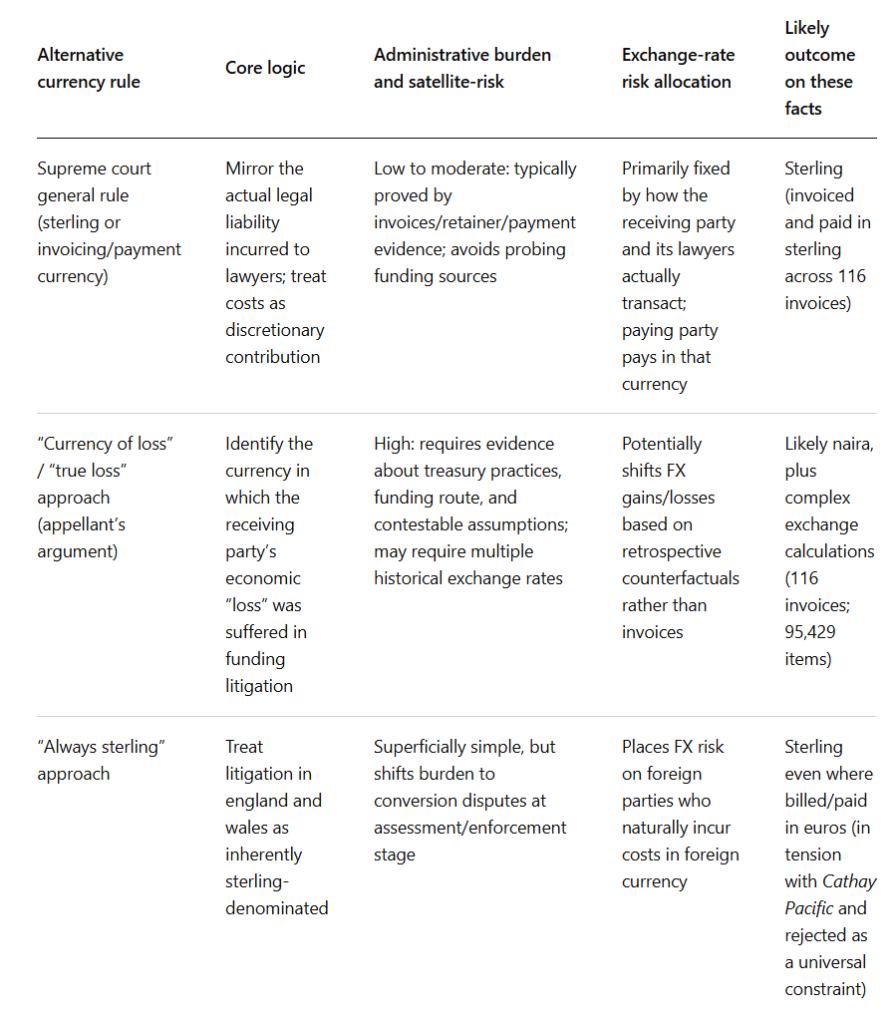
Table: how alternative currency-selection rules would play out
The table below contrasts (i) the rule the supreme court adopted with (ii) the “currency of loss” approach argued for by the appellant and (iii) an “always sterling” approach that was argued against in Cathay Pacific and rejected in principle. The comparisons are grounded in the reasoning about discretion, proportionality, and the risks of collateral inquiries.
Implications, criticisms, and practitioner guidance
Litigation strategy is likely to adjust around the insight that currency is now, presumptively, a function of the retainer and invoicing arrangements rather than a court-led exercise in economic loss measurement. For well-resourced foreign parties litigating in england and wales, the decision creates an incentive to think early about (i) what currency liability they are willing to incur to their lawyers and (ii) whether they want the symmetry of costs recovery in that same currency, knowing that courts will ordinarily follow the billing-and-payment currency absent abuse.
Costs budgeting and costs management take on particular importance in cross-border disputes. The judgment expressly links the currency question to the court’s “methods of cost control, including costs budgeting”, and flags possible future practice direction responses if foreign-currency billing becomes more common. Practitioners should therefore expect judicial scrutiny if a foreign-currency approach would undermine budgeting comparability or introduce exchange-rate volatility that budgets are not designed to model.
For paying parties, the decision provides a principled basis to resist attempts to turn costs submissions into mini-trials on how the opponent financed the litigation. The supreme court’s repeated emphasis on disproportionate fact disputes and satellite litigation equips paying parties to challenge disclosure requests or evidential excursions that go beyond the narrow proof of currency of liability and payment.
For receiving parties (especially sovereigns and large corporates), the judgment also suggests a pragmatic discipline: if a party wants an order in a non-sterling currency, it should be able to show a genuine connection to that currency through its actual invoicing and payment arrangements, rather than by asserting a notional “loss” in a domestic currency. Where that genuine connection exists, the court’s endorsement of the Cathay Pacific outcome indicates that foreign-currency costs orders remain available.
Enforcement implications should be framed cautiously. The judgment itself does not set out mechanics for enforcing foreign-currency costs orders, but it does recognise “significant currency fluctuations” as a risk to paying parties, reinforcing the practical reality that currency denomination can affect the amount the paying party must procure at the point of payment. For claims and pleadings generally, CPR PD 16 requires a foreign currency claim to state the sterling equivalent at the claim date and the source of the exchange rate; Cathay Pacific treated analogous informational discipline (notice and sterling equivalents) as sensible when seeking foreign-currency costs on summary assessment.
Potential criticisms of the decision largely turn on perceived under-compensation and perceived manipulability. A losing party might say that, where a foreign state or company truly funds litigation from domestic-currency revenues, a sterling-denominated costs order may over- or under-state the real domestic economic burden. The supreme court’s answer is structural: costs are not designed to restore a party to a no-litigation counterfactual position, and the court should not be drawn into measuring “loss” in that sense. Critics will therefore need to confront the court’s procedural conception of costs rather than proposing marginal adjustments to exchange-rate methodology.
A further unresolved question is how the general rule operates in genuinely mixed-currency cost structures (for example, where solicitors bill in one currency but substantial disbursements, experts, or counsel fees arise in another; or where a party uses multiple law firms with different billing currencies). The supreme court’s rule speaks in single-currency terms (“the currency” in which the solicitor billed and the client paid), and the present case did not require analysis of mixed-currency practice. This suggests future litigation may explore whether courts (i) issue split-currency costs orders, (ii) default to sterling for manageability, or (iii) treat non-billing-currency elements through assessment-stage conversion.
A second unresolved question concerns institutional design: the court explicitly contemplated practice directions if foreign-currency costs recovery becomes more common. That signals a potential evolution from ad hoc discretion to more formal disclosure and budgeting protocols (for example, mandatory early notification that a party is being billed in a foreign currency, and agreed conversion conventions for budgets). That future move would sit consistently with the court’s emphasis on proportionality and costs control, but it is not yet implemented and therefore remains a live governance question for procedural rule-makers.
Best-practice guidance for practitioners can be distilled into the following operational steps, all aligned with the judgment’s emphasis on certainty, proportionality, and avoiding collateral inquiry.
First, decide currency early and document it. If a non-sterling costs order is desired, structure the legal engagement so that the client genuinely incurs liability in that currency (and can evidence payment or liability to pay in that currency), ensuring there is a real connection and no appearance of opportunistic currency speculation.
Second, manage notice and budgeting risk. Even though the supreme court only suggested potential future practice directions, it explicitly identified party awareness and budgeting safeguards as likely pressure points. In practical terms, if foreign-currency billing is used, provide early, clear notice to the other side and the court, and be ready to supply sterling equivalents for budgeting and costs-management purposes (an approach consistent with the information discipline discussed in Cathay Pacific and with PD 16’s requirements for foreign-currency money claims).
Conclusion
[2025] UKSC 36 establishes a clean, workable default rule for the currency of costs: costs are not damages, and the court should not conduct a “true loss” inquiry into a party’s funding arrangements. Currency ordinarily follows the solicitor-client liability: sterling, or the currency of invoicing and payment, subject to a limited abuse-based override and possible future procedural safeguards if foreign-currency costs become common in practice.
Cite this work:
To cite this resource, please use the following reference:
National Case Law Archive, 'Process & Industrial Developments Ltd v The Federal Republic of Nigeria: currency of costs after [2025] UKSC 36' (LawCases.net, November 2025) <https://www.lawcases.net/analysis/process-industrial-developments-ltd-v-the-federal-republic-of-nigeria-currency-of-costs-after-2025-uksc-36/> accessed 27 July 2026