In Providence Building Services Limited v Hexagon Housing Association Limited the UK Supreme Court has resolved a narrow but high-impact question of contractual interpretation in the JCT Design and Build Contract 2016 termination regime: can a contractor terminate under clause 8.9.4 for a repeated “specified default” where the earlier default was cured within the 28‑day period, so that the clause 8.9.3 right to terminate never arose?
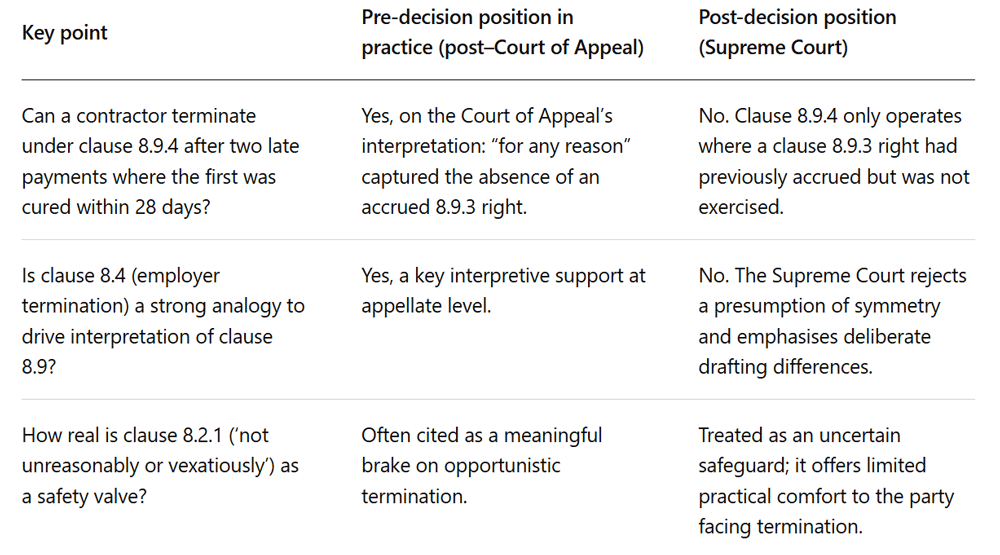
The Court unanimously allowed the employer’s appeal and restored the first-instance approach (overturning the Court of Appeal). The core holding is that clause 8.9.4 is not a free-standing “two strikes and you’re out” power. It is contingent: clause 8.9.4 only applies where, in respect of an earlier specified default, the contractor did acquire a clause 8.9.3 right to terminate (because the default continued for the 28-day period) but then, “for any reason”, did not serve the clause 8.9.3 termination notice.
For practising solicitors, the judgment has immediate consequences for advice to both employers and contractors using JCT D&B 2016 (and (per the judgment) the 2024 edition, whose relevant wording is unchanged). It narrows the circumstances in which an employer’s second late payment can trigger immediate termination, and it reinforces an orthodox approach to standard-form interpretation: courts will not re-engineer termination drafting to address perceived cash-flow unfairness; if the industry wants a different risk allocation, the standard-form drafter must change the text.
Facts and procedural history
The judgment concerns a contract (February 2019) for construction of “a number of buildings” in Purley, with an original contract sum of approximately £7.2m. The contract incorporated the JCT Design and Build standard form (2016 edition) with relatively minor bespoke amendments. The nature of the buildings and the broader project chronology are otherwise unspecified in the judgment.
Two interim payments are central:
In November 2022, the employer’s agent issued Payment Notice 27 requiring payment of £264,242.55 by 15 December 2022. The employer did not pay by that final date. The contractor served a clause 8.9.1 notice of specified default on 16 December 2022. The employer paid in full on 29 December 2022 (ie within 28 days of receipt of the specified default notice), with the result—common ground—that the contractor never became entitled to serve the further termination notice under clause 8.9.3 for that default.
In April 2023, Payment Notice 32 required payment of £365,812.22 by 17 May 2023. That sum was not paid by the due date. On 18 May 2023, the contractor served a notice purporting to terminate under clause 8.9.4, treating the May late payment as a “repetition” of the specified default notified in December 2022.
In the same 18 May 2023 letter, the contractor also asserted termination at common law, characterising repeated late payments as repudiatory breaches (it alleged 19 late payments out of 32). The Supreme Court judgment does not determine whether there was a repudiatory breach at common law; the proceedings were focused on the contractual notice machinery.
The employer paid the May sum on 23 May 2023, disputed the contractual termination, and asserted that the contractor had repudiated. The employer later purported to accept the contractor’s repudiation. The dispute went to adjudication (the adjudicator found largely for the employer), followed by Part 8 proceedings for declaratory relief on the interpretation of clauses 8.9.3 and 8.9.4.
At first instance in the Technology and Construction Court Technology and Construction Court, Adrian Williamson KC (sitting as a Deputy High Court Judge) favoured the employer’s construction. The Court of Appeal Court of Appeal reversed that outcome. The employer appealed, and the Supreme Court handed down judgment on 15 January 2026, allowing the appeal. “I would allow the appeal.” (para 39).
The contractual machinery and the issue
The dispute turns on clause 8.9 (termination by contractor) and its relationship with clause 8.4 (termination by employer). The contract (as amended) provided that if the employer did not pay by the final date for payment an amount due to the contractor, the contractor could serve a notice specifying the default (a “specified default”). Clause 8.9.3 then allowed termination if a specified default continued for 28 days from receipt of that notice, by serving a further notice within 21 days after expiry of the 28‑day period. Clause 8.9.4 addressed “repetition” where “for any reason” the further notice under 8.9.3 was not given, allowing termination upon or within a reasonable time (amended to 28 days) after the repetition.
Two contextual points mattered in the Court’s analysis:
- First, it was common ground that, in a late-payment context, “repetition” refers to late payment in a subsequent payment cycle, not a reoccurrence of the same month’s payment default.
- Second, clause 8.2.1 applied to termination notices generally: “Notice of termination of the Contractor’s employment shall not be given unreasonably or vexatiously.” The contractor argued that this constraint would prevent abusive termination for minor repeated late payment; the Supreme Court treated it as an uncertain and difficult safeguard for an employer to rely upon in practice.
Against that background, the agreed interpretive issue was whether clause 8.9.4 can be used even where no clause 8.9.3 right to terminate had previously accrued. Put simply: does clause 8.9.4 require that the contractor could have served the clause 8.9.3 termination notice earlier, but chose not to? Or can it be triggered merely because there was an earlier specified default notice (even if cured within the 28-day period) followed by a later repeat default?
What the Supreme Court decided and why
The Supreme Court approached the question as a matter of objective contractual interpretation in context. It reiterated modern interpretive principles (objective meaning, contextual reading, limited role for “business common sense”, and the general inadmissibility of prior negotiations for construing meaning).
It also addressed the added dimension of industry standard forms: while the same objective interpretive approach applies, the relevant background is often what would generally be known to market participants using the form, and consistency of interpretation across users is typically expected.
The core construction: clause 8.9.4 is dependent on clause 8.9.3
The decisive reasoning is textual and structural. The opening words of clause 8.9.4—“If the Contractor for any reason does not give the further notice referred to in clause 8.9.3 …”—were treated as doing real work. If clause 8.9.4 were truly independent, the Court said, those opening words would be unnecessary; the clause would simply begin with the employer’s repetition of a specified default. On the Court’s construction, the opening words signal that clause 8.9.4 presupposes the existence of a clause 8.9.3 right which the contractor has not exercised. The judgment encapsulates the relationship in a phrase that will likely find its way into many client notes: “clause 8.9.3 is the ‘gateway’ to clause 8.9.4” (para 32).
That construction produces a materially narrower “repeat default” termination power. A contractor cannot “bank” a specified default notice served for a default that was cured within the 28-day period and then terminate immediately when another late payment occurs months later. Instead, clause 8.9.4 only comes into play if an earlier specified default continued for the full 28‑day period, thereby giving rise to a clause 8.9.3 right to terminate. If the contractor then does not exercise that right (for any reason), and the employer later repeats the default, clause 8.9.4 provides a further route to termination.
Avoiding “extreme outcomes” and the limits of the ‘unreasonably or vexatiously’ control
The Supreme Court also used outcome-based reasoning as a cross-check. It considered that the contractor’s construction would lead to “an extreme outcome”: a contractor could terminate for a second late payment even where both late payments were trivial in duration (for example, one day late), so long as a specified default notice had been served in relation to the first late payment. The judgment’s memorable description – “sledgehammer to crack a nut” (para 35) – captures the Court’s discomfort with that result.
A key practical point for advisers is the Court’s treatment of clause 8.2.1 (not unreasonably or vexatiously). The contractor argued that clause 8.2.1 would prevent opportunistic termination for minor delays. The Supreme Court accepted the first-instance view that this gives little comfort to an employer faced with termination because the employer must shoulder the “tricky and nebulous” evidential burden of showing unreasonableness or vexation; the Court endorsed this concern with the short quotation: “that gives scant comfort” (para 35).
Rejecting symmetry arguments: clause 8.4 is not a template for clause 8.9
The Court of Appeal had placed significant weight on clause 8.4 (employer termination) and the similarity in the clause structures. The Supreme Court’s response is important for anyone who advises on standard forms: do not presume symmetry where the drafting is not symmetrical.
The Court gave three main reasons why reliance on clause 8.4 was misplaced. In short:
- there is no general interpretive principle that employer and contractor termination rights must mirror each other (their obligations differ materially);
- the contract’s termination regime was already demonstrably asymmetrical (including different time periods and different categories of “specified default”); and
- critically, the wording differs between clause 8.4.3 and clause 8.9.4, and (given the care with which JCT drafting is produced) that difference is more naturally explained as a deliberate signal that the clauses do different things—clause 8.4.3 makes clear no accrued right is needed; clause 8.9.4 does not.
No “cash-flow fix” by interpretation
Finally, the Court addressed an argument that has strong practical resonance in construction disputes: if clause 8.9.4 is construed narrowly, does it leave contractors exposed to persistent late payment (so long as each payment is made within 28 days)?
The Court’s answer is direct: courts should not adjust the meaning of the termination clause to protect contractors from cash-flow difficulties. “the interpretation of the disputed termination clause should not be distorted so as to favour the Contractor” (para 38).
Any perceived inadequacy in the termination remedy, the Court indicated, is for the standard-form drafter to address in future editions.
Practical implications for solicitors
This is a contract-interpretation decision, but it has a strongly operational flavour: it is about how and when termination may lawfully be triggered, and therefore about avoiding wrongful termination.
Advising contractors: notice discipline and alternative remedies
The immediate client-facing message is that clause 8.9.4 is not a shortcut to immediate termination on a second late payment where the first default was cured quickly. The solicitor’s practical risk here is not merely that a termination notice will be ineffective, but that the client may be exposed to a counter-allegation of repudiation for wrongful termination (precisely the escalation seen in the facts).
When advising a contractor considering termination for late payment under JCT D&B provisions in this form, the safest workflow is:
- Analyse whether a clause 8.9.3 right ever accrued in respect of an earlier default. That is a date-calculation exercise anchored to (i) receipt of the specified default notice and (ii) whether the default continued for the full 28 days. If the earlier default was cured within the 28 days, clause 8.9.4 cannot be used for a later repetition.
- If the client’s objective is cash-flow rather than exit, treat termination as a last resort and actively discuss statutory and contractual tools. The judgment itself notes other “weapons” commonly deployed in the late-payment context (including suspension and statutory interest), even though it ultimately refused to let those policy considerations drive interpretation.
- A party to a construction contract has a statutory right to refer disputes to adjudication “at any time” (subject to the Act’s framework), which is frequently used to obtain enforceable payment decisions quickly.
- Where a sum due is not paid by the final date for payment, section 112 of the Housing Grants, Construction and Regeneration Act 1996 gives a right to suspend performance, subject to notice requirements.
- Depending on contract type and parties, statutory interest may be available for late payment under the Late Payment of Commercial Debts (Interest) Act 1998 and associated guidance.
- If termination remains on the table, test the ‘unreasonably or vexatiously’ constraint early. The Supreme Court’s scepticism about clause 8.2.1 as a reliable safeguard does not make it irrelevant; rather, it underscores that disputes about the clause are fact-heavy and risky, and that well-documented decision-making will matter.
- Consider bespoke drafting at contract formation if contractors want a true “repeat late payment” termination right. The Supreme Court signals that reforms are for the drafter, not judicial interpretation; that is an invitation for proactive amendments (where bargaining power allows).
Advising employers: managing the 28-day risk and avoiding the ‘gateway’ event
For employers, the decision reduces the risk of an immediate termination attempt following a second late payment where the first was remedied within 28 days. Put bluntly: paying within the 28-day cure window prevents the clause 8.9.3 right accruing, and therefore prevents clause 8.9.4 from being engaged by a later repetition.
However, employers should not take false comfort:
- The statutory suspension right (and adjudication) remain powerful levers, and can disrupt projects even where contractual termination is unavailable.
- Persistent late payment can still generate wider disputes (including alleged repudiation) even if clause 8.9.4 is unavailable; the judgment records that repudiation was asserted on both sides in this case, though it did not decide the point.
From a solicitor’s perspective, the practical advice is to tighten payment governance and evidence: ensure payment notices, pay less notices (if applicable), and payment authorisation steps are diarised; confirm service / receipt mechanics; and, where late payment occurs, consider early engagement to prevent escalation into suspension/termination pathways. The operationalisation of “receipt” dates can be decisive in calculating the 28-day period.
Litigation and dispute strategy: a renewed focus on declaratory relief and clean factual records
This dispute was progressed via Part 8 declaratory proceedings because the parties sought a ruling on a question unlikely to involve substantial dispute of fact—an appropriate procedural vehicle where the key question is construction of a contractual clause on agreed facts.
For dispute-resolution solicitors, the lesson is twofold. First, termination disputes are high-stakes because an invalid termination can itself sound in repudiation arguments—often triggering a cascade of claim/counterclaim about losses, step-in costs, and final account. Second, the cleaner the factual record on notices, receipt, and timelines, the more viable a focused Part 8 route becomes for obtaining early clarity.
What happens next
The judgment is likely to shape how termination disputes are pleaded and how projects are managed under JCT forms.
From a litigation perspective, expect arguments to concentrate on the boundaries left open by this “gateway” construction: what counts as a “repetition” in less straightforward factual matrices; what constitutes “receipt” and how it is evidenced; and whether particular terminations were “unreasonable or vexatious” (especially where the contractor’s commercial aim is leverage rather than exit).
From a drafting and industry perspective, the Supreme Court explicitly points away from judicial re-interpretation and towards amendment by the standard-form producer if the remedy balance is thought unsatisfactory (and it notes that the 2024 edition preserved the same relevant termination wording). That combination is likely to drive pressure for either (a) bespoke amendments in negotiated contracts or (b) future tweaks by the Joint Contracts Tribunal Joint Contracts Tribunal in later editions or guidance.
Cite this work:
To cite this resource, please use the following reference:
National Case Law Archive, 'JCT termination after Providence v Hexagon: the Supreme Court closes the ‘repeat default’ shortcut' (LawCases.net, February 2026) <https://www.lawcases.net/analysis/jct-termination-after-providence-v-hexagon-the-supreme-court-closes-the-repeat-default-shortcut/> accessed 26 July 2026
Articles and content on this site are for informational purposes only and do not constitute legal advice. Do not rely solely on this information.