

Assault and battery represent two of the oldest and most fundamental offences known to the common law of England. Though the terms are frequently used interchangeably in popular discourse, they are in law distinct concepts, each protecting a different dimension of the individual. Assault guards the mind against the fear of violence; battery guards the body against its actual infliction. Together they form the bedrock upon which the entire edifice of non-fatal offences against the person has been constructed over several centuries.
This guide traces the historical origins and doctrinal development of these offences, examines the leading cases that have shaped their contours, and considers their place in the modern criminal law of England and Wales.
Historical foundations
The roots of assault and battery reach deep into the medieval common law. The early law of trespass, from which both offences descend, drew no sharp line between civil wrongs and criminal acts. A battery – the direct and forcible application of harm to another’s person – was actionable as a trespass vi et armis, and the same conduct could also be prosecuted as a breach of the King’s peace. By the seventeenth century, the courts had clearly articulated the distinction between the two wrongs: assault, being the creation of an apprehension of imminent force, and battery, being the actual application of that force.
The enduring authority of Tuberville v Savage (1669) 2 Keb 545 illustrates how early the courts grappled with the boundaries of assault. In that case, the defendant placed his hand upon his sword hilt and declared, “If it were not assize-time, I would not take such language from you.” The court held that no assault had been committed. The words accompanying the gesture negated any apprehension of immediate violence; because the assize judges were in town, the defendant was signalling restraint, not threat. The case established the important principle that words may qualify, and indeed negate, what would otherwise be a threatening act – a principle that has survived unchanged for over three and a half centuries.
Throughout the eighteenth and nineteenth centuries, the offences developed primarily through common law decisions. Blackstone, in his Commentaries on the Laws of England, famously observed that “the law cannot draw the line between different degrees of violence, and therefore totally prohibits the first and lowest stage of it; every man’s person being sacred, and no other having a right to meddle with it, in any the slightest manner.” This passage, subsequently cited with approval by the courts on numerous occasions, captures the animating principle behind battery: the absolute protection of bodily integrity, irrespective of the degree of force employed.
The modern statutory framework
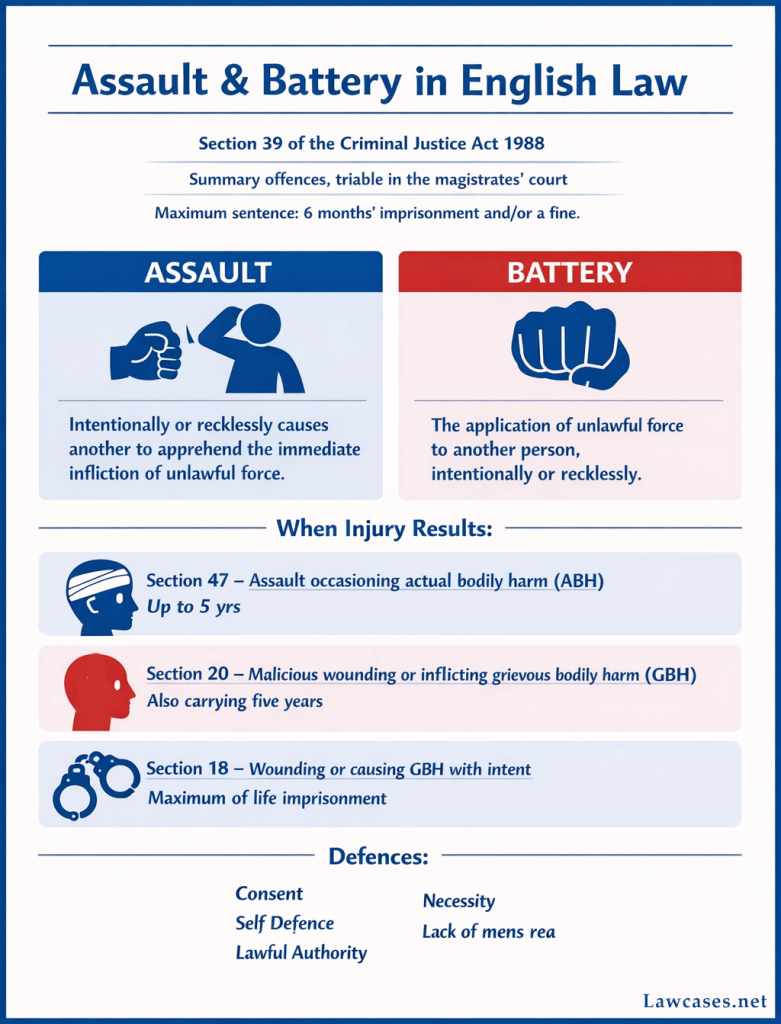
Despite their ancient common law origins, assault and battery were given a statutory home – albeit a rather modest one – by section 39 of the Criminal Justice Act 1988. That section classifies common assault and battery as summary offences, triable in the magistrates’ court, carrying a maximum sentence of six months’ imprisonment and/or a fine.
It is important to appreciate, however, that section 39 does not define either offence. The elements of assault and battery remain creatures of the common law, and it is to the case law that one must turn for their substantive content. The statute merely prescribes the mode of trial and maximum penalty, leaving the courts to continue developing the law through judicial decision.
Where the application of force results in injury, the offence escalates beyond common assault and battery into the territory of the Offences Against the Person Act 1861:
- Section 47 – assault occasioning actual bodily harm (ABH), carrying a maximum of five years’ imprisonment;
- Section 20 – malicious wounding or inflicting grievous bodily harm (GBH), also carrying five years;
- Section 18 – wounding or causing GBH with intent, carrying a maximum of life imprisonment.
The relationship between common assault, battery, and these aggravated offences forms a hierarchy of seriousness that structures the prosecution of violent crime in England and Wales to this day.
The elements of assault
Definition
Assault is committed when a person intentionally or recklessly causes another to apprehend the immediate infliction of unlawful force. No physical contact is required. The offence is concerned entirely with the effect upon the victim’s mind: did the complainant genuinely fear that violence was about to be visited upon them?
Apprehension of immediate violence
The requirement of immediacy has been the subject of considerable judicial attention. In Smith v Superintendent of Woking Police Station [1983] Crim LR 323, the defendant terrified a woman in her ground-floor flat by staring through the windows at her late at night. Though the defendant was outside the building, the Divisional Court held that there was sufficient evidence of an apprehension of immediate violence. Crucially, the court observed that it was not necessary for the prosecution to establish precisely what the victim feared would happen; a general apprehension of some imminent violence was enough.
Words, gestures, and conditional threats
As Tuberville v Savage demonstrated, words can negate an otherwise threatening gesture. But the converse is equally true: words alone, unaccompanied by any physical act, may in appropriate circumstances constitute an assault. The old common law rule, sometimes attributed to Holroyd J, that “mere words do not constitute an assault” has been progressively abandoned.
In R v Constanza [1997] Crim LR 576, the Court of Appeal held that letters could amount to an assault where they caused the victim to apprehend immediate violence. The defendant had engaged in a sustained campaign of harassment against a former colleague, involving over 800 letters, silent telephone calls, and repeated uninvited visits. The final two letters caused the victim to apprehend that the defendant might use violence against her at any time, and this was held sufficient.
The House of Lords confirmed and extended this principle in the landmark decision of R v Ireland; R v Burstow [1998] AC 147, in which Lord Steyn held that silent telephone calls could constitute an assault. His Lordship reasoned that a silent caller who rings repeatedly in the night may cause the victim to apprehend immediate violence – the caller might, for all the victim knows, be outside the door. The decision firmly established that the means by which the apprehension is created are immaterial; what matters is the state of mind engendered in the complainant.
Recklessness
The mens rea for assault may be satisfied by recklessness as well as intention. In Logdon v DPP [1976] Crim LR 121, the defendant pointed a replica gun at the victim as a joke. The victim was terrified until told the weapon was not real. The court convicted the defendant, holding that even though the gun was a replica, the victim had apprehended immediate physical violence, and the defendant had been at least reckless as to whether this apprehension would arise.
The test for recklessness in this context is subjective, following R v Cunningham [1957] 2 QB 396: the defendant must have foreseen the risk that the complainant would apprehend immediate unlawful violence but proceeded regardless.
The elements of battery
Definition
Battery is the application of unlawful force to another person, intentionally or recklessly. Unlike assault, it requires actual physical contact, however slight. As the Court of Appeal made clear in the seminal case of Collins v Wilcock [1984] 1 WLR 1172, “the least touching of another in anger is a battery”.
The breadth of “force”
The term “force” is interpreted with considerable generosity. No injury need result; no pain need be caused. The offence is complete upon any unwanted touching. This principle reflects the law’s protection not merely of physical safety but of personal autonomy and bodily integrity.
Battery has been held to encompass:
- Spitting upon another person;
- Throwing a substance, such as water or beer, over someone;
- Cutting hair without consent;
- Any unwanted touching, however trivial, provided it goes beyond the bounds of everyday, socially acceptable contact.
In R v Savage [1992] 1 AC 699, the defendant threw beer over the complainant. As she did so, the glass slipped from her hand and cut the complainant’s wrist. The House of Lords held that the act of throwing the beer was itself a battery, and that the defendant need not have intended or foreseen the precise degree of force applied – only that some unlawful force would result. This case is also significant for its treatment of the mens rea for section 47 of the 1861 Act, the Lords holding that no additional mens rea beyond that required for the underlying assault or battery need be proved.
Indirect force
Battery need not involve direct person-to-person contact. In DPP v K [1990] 1 WLR 1067, a schoolboy placed sulphuric acid in a hand dryer. Another pupil used the dryer and was sprayed with the acid, suffering burns. The court held that this constituted a battery. The defendant need not personally have touched the victim; it sufficed that he had set in motion the chain of events that resulted in force being applied to the complainant’s person.
Similarly, in Haystead v Chief Constable of Derbyshire [2000] 3 All ER 890, the defendant punched a woman who was holding a child. The woman dropped the child, who was injured. The Divisional Court held that the defendant had committed a battery against the child, even though he had not directly touched the infant. The force had been applied indirectly, through the medium of the mother.
Consent and the boundaries of lawful touching
Everyday contact
One of the most sophisticated aspects of the law of battery is the doctrine of implied consent to the ordinary physical contacts of daily life. Without such a doctrine, the law would criminalise every accidental jostling on a crowded street or tap on the shoulder.
In Collins v Wilcock, Robert Goff LJ explained the principle with characteristic clarity. His Lordship held that the public generally consents to the physical contacts that are an inevitable part of everyday life: the handshake, the tap on the shoulder to attract attention, the accidental brushing against another passenger on a bus. Such contacts are not unlawful because they fall within the scope of implied consent, provided that no greater degree of physical contact is used than is reasonably necessary in the circumstances.
Consent in sport and surgery
The law has long recognised that consent may be given to physical contacts that would otherwise constitute battery. Participants in contact sports such as rugby or boxing consent to the physical contacts inherent in those activities, provided the contact falls within the rules of the game. Similarly, a patient who consents to a surgical procedure cannot subsequently complain of a battery.
However, consent has its limits. In R v Brown [1993] UKHL 19, the House of Lords held, by a majority of three to two, that consent was no defence to the infliction of actual bodily harm or worse for the purposes of sadomasochistic activity. The decision remains one of the most controversial in the modern criminal law, raising fundamental questions about the extent to which the state may override individual autonomy in the regulation of private conduct.
The decision in Brown was subsequently distinguished in R v Wilson [1997] QB 47, in which the Court of Appeal held that a husband who branded his initials on his wife’s buttocks with her consent had not committed an offence. Russell LJ distinguished Brown on the basis that the branding was akin to tattooing – a form of personal adornment to which consent was a valid defence. The tensions between Brown and Wilson have never been fully resolved, and the boundaries of lawful consent to physical harm remain a live and contested area of the law.
Assault occasioning actual bodily harm
Where an assault or battery results in actual bodily harm, the offence is elevated to one contrary to section 47 of the Offences Against the Person Act 1861. Actual bodily harm has been interpreted to mean “any hurt or injury calculated to interfere with the health or comfort of the victim,” provided it is more than merely transient or trifling – a definition established in R v Miller [1954] 2 QB 282 and refined in R v Chan-Fook [1994] 1 WLR 689.
A landmark extension of the concept of actual bodily harm came in R v Ireland; R v Burstow, where the House of Lords confirmed that psychiatric injury, as distinct from mere distress or anxiety, could constitute actual bodily harm. This brought the law into alignment with modern medical understanding that psychological harm may be every bit as real and debilitating as physical injury.
The case of R v Roberts (1971) 56 Cr App R 95 illustrates the breadth of the causal nexus required under section 47. The defendant made unwanted sexual advances to a woman travelling in his car. Fearing rape, she jumped from the moving vehicle and suffered grazing and concussion. Stephenson LJ held that the test for causation was whether the victim’s reaction was a reasonably foreseeable consequence of the defendant’s conduct. Since jumping from the car was a natural response to the fear the defendant had created, the chain of causation was not broken.
Defences
The principal defences to assault and battery may be briefly summarised:
| Defence | Essence |
|---|---|
| Consent | The complainant genuinely agreed to the application of force, subject to the limits discussed above |
| Self-defence | The defendant used reasonable force to protect themselves or another from an imminent attack |
| Lawful authority | The defendant was exercising a lawful power, such as the power of arrest |
| Necessity | The defendant acted to prevent a greater harm |
| Lack of mens rea | The defendant neither intended nor was reckless as to the relevant consequence |
Self-defence merits particular mention. The test, as established in a long line of authorities and now given partial statutory expression by section 76 of the Criminal Justice and Immigration Act 2008, is whether the force used was reasonable in the circumstances as the defendant genuinely believed them to be. A person who honestly but mistakenly believes they are under attack may rely on self-defence, even if the mistake was unreasonable – though the reasonableness of the belief will be relevant to whether it was genuinely held.
Modern developments and continuing relevance
The law of assault and battery continues to evolve. Several developments in recent decades deserve attention.
First, the recognition that words alone, and even silence, can constitute an assault – confirmed in Ireland and Burstow – has enabled the law to address modern forms of intimidation, including harassment by telephone and electronic communication. As stalking and online threats have become more prevalent, these principles have assumed ever greater practical importance.
Second, the courts have increasingly recognised the significance of psychiatric harm. The equation of recognisable psychiatric illness with actual bodily harm has ensured that the law protects not only physical but also mental well-being – a development of considerable importance in an age of heightened awareness of mental health.
Third, the ongoing debate about the limits of consent, opened by Brown and left unresolved by Wilson, continues to provoke academic and judicial discussion. The question of how far the law should permit individuals to consent to the infliction of harm upon their own bodies touches upon fundamental values of autonomy, paternalism, and the proper scope of the criminal law.
Fourth, the enactment of specific statutory offences – such as those relating to stalking (sections 2A and 4A of the Protection from Harassment Act 1997, inserted by the Protection of Freedoms Act 2012) – has not displaced the common law of assault and battery but has supplemented it, providing prosecutors with a broader toolkit for addressing violent and intimidatory behaviour.
Conclusion
Assault and battery, though ancient in origin, remain vigorously alive in the modern law of England and Wales. From Tuberville v Savage in 1669 to the House of Lords’ decisions in Ireland and Burstow and R v Brown, the courts have continually adapted these foundational offences to meet the demands of changing social conditions. The principles are deceptively simple – the protection of the mind from the fear of violence and the body from its infliction – yet their application raises questions of considerable subtlety and importance.
As Blackstone recognised, every person’s body is sacred, and the law tolerates no uninvited interference with it, however slight. This principle, articulated over two centuries ago, remains the lodestar of the English law of assault and battery. It is a principle at once ancient and modern, and one that is likely to endure for as long as the common law itself.
See also: Assault and battery cases
Cite this work:
To cite this resource, please use the following reference:
National Case Law Archive, 'Assault and battery in English law' (LawCases.net, March 2026) <https://www.lawcases.net/guides/assault-and-battery-in-english-law/> accessed 14 August 2026


