

In Veale (and others) v Scottish Power UK Plc, the UK Supreme Court was asked a tight but commercially significant question: where an injured person settles (and thereby discharges the defender’s liability) before developing mesothelioma, can the statutory “mesothelioma exception” still allow the person’s relatives to pursue the non‑patrimonial head of claim after the person later dies of mesothelioma? The Court’s answer is yes.
The Court held that section 5(1)(a) of the Damages (Scotland) Act 2011 does not require that the deceased was already suffering from mesothelioma at the time they discharged liability; it is sufficient that liability to the deceased (or executor) was discharged before death, and that the death was caused by mesothelioma (and the temporal condition in section 5(1)(c) is met).
For legal practitioners, the practical impact is immediate in any organisation with legacy asbestos exposure (including utilities, construction, manufacturing, transport, estates/real‑asset owners, and their insurers): “full and final” settlements with employees/claimants for asbestos‑related conditions may still leave a residual statutory exposure to relatives’ non‑patrimonial claims if the claimant later dies from mesothelioma. That is risk‑allocation, reserving, and documentation work, not just litigation theory. The judgment also supplies a crisp reminder of interpretative discipline: if the statutory wording is clear, courts will not “distort” it to match a narrower mischief narrative, nor will they “rewrite” conditions into the statute.
Key takeaways for practice are:
- The issue the Court decided was exactly whether it is “essential that A was suffering from mesothelioma” at the time of discharge (para 5). The Court rejected that requirement.
- The Court treated “liability to pay damages” as a consistent phrase across sections 3, 4 and 5; section 5(1)(a) uses general language, and mesothelioma enters via section 5(1)(b), not by implication into section 5(1)(a) (paras 12–15).
- The judgment confirms that, “on any view”, section 5 enables relatives to claim after liability to the injured person was discharged (para 27), and the appeal was dismissed (para 29).
- The decision is broad within its statutory field (it captures discharges before diagnosis and even before disease develops), but tightly limited to the Scottish statutory scheme and to mesothelioma (paras 25, 28).
- Assumptions: this note assumes readers are comfortable with basic settlement mechanics, statutory interpretation, and the distinction between the injured person’s claim and relatives’ claims in Scots wrongful‑death damages. The judgment does not address limitation, contribution, insurance coverage disputes, or enforceability of third‑party waivers; where those issues matter, they are flagged as unspecified.
Factual background
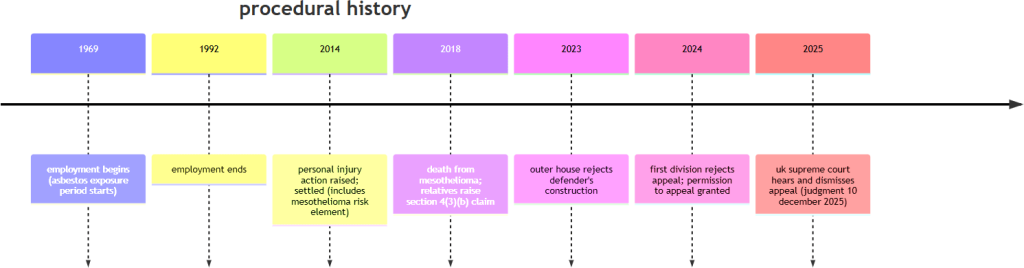
The pursuers were members of the immediate family of Robert Crozier, who died of mesothelioma in 2018. He had worked for the defender employer between 1969 and 1992. In 2014, he sued for damages after developing pleural plaques and asbestosis, and his claim included damages relating to the risk of developing mesothelioma. The action settled; at settlement he was not suffering from mesothelioma. The settlement discharged the defender’s further liability to him, including (on the parties’ common ground) any liability if he later developed mesothelioma.
After his death, the relatives raised proceedings seeking the section 4(3)(b) head of damages (non‑patrimonial elements). The defender argued that the relatives’ claim was barred by section 4(2) because liability to Mr Crozier had been discharged pre‑death. The relatives relied on the specific statutory carve‑out: “except as provided for in section 5”. The Court records that the defender accepted the “mesothelioma” and “post‑20 December 2006” conditions, but contended section 5(1)(a) was not satisfied because Mr Crozier did not have mesothelioma at discharge.
The argument failed in the Outer House, failed again in the First Division, and permission to appeal was granted. The Supreme Court dismissed the appeal, essentially for the reasons given below, and aligned itself with the courts below.
Procedural timeline (dates and steps as stated in the judgment):
Legal issues
The statutory architecture matters. Sections 3 to 5 of the Damages (Scotland) Act 2011 set when relatives can claim and what happens when the injured person has settled or otherwise discharged liability. In outline (and using the Court’s own extracts), sections 4 to 6 apply where a person dies due to personal injuries caused by another’s act/omission and that act/omission gives rise to liability to pay damages (section 3). Section 4 then creates liabilities to relatives, and section 4(2) contains a general bar: no liability to relatives arises if liability to the injured person (or executor) is excluded or discharged by the injured person before death — except as provided for in section 5.
Section 5 is the targeted exception. Where (a) liability to the injured person (or executor) is discharged by the injured person pre‑death, (b) the personal injury causing death is mesothelioma, and (c) both discharge and death occur on/after 20 December 2006, “liability arises” under section 4(1) but is limited to the section 4(3)(b) sum (non‑patrimonial loss elements: distress/anxiety, grief/sorrow, and loss of society/guidance).
The Supreme Court framed the appeal’s issue with precision: “whether… it is essential that A was suffering from mesothelioma at the time when the liability… was discharged” (para 5). This is best read as a question about the conditions for engaging section 5, not as a broad revisiting of wrongful‑death damages generally.
Supreme Court’s reasoning and holdings
The Court’s operative holding is that section 5(1)(a) does not carry an implied “mesothelioma-at-discharge” requirement. The Court’s route to that conclusion has four practical lessons: read the text, read it consistently across interconnected provisions, treat headings and background materials with discipline, and avoid “absurdity” arguments that are really policy disagreements.
First, the defender’s textual move was to treat “liability to pay damages” in section 5(1)(a) as meaning liability to pay damages for mesothelioma, and then say no such liability existed when liability was discharged because the deceased did not then have mesothelioma (para 10). The Court rejected that, noting (among other points) that the settled claim included damages for the risk of future mesothelioma, and the settlement discharged liability if mesothelioma later developed (para 11). For legal practitioners, this matters because “risk of future disease” is common in asbestos settlements; the judgment treats that risk‑element as sufficient to make the defender’s argument untenable even on its own premise.
Secondly (and more fundamentally), the Court insisted that “liability to pay damages” must mean the same thing in sections 3, 4 and 5 because the provisions are expressly inter‑linked (paras 12–15). In particular, the Court’s point is that section 3 is plainly not mesothelioma‑specific, so it is “inconceivable” to construe the phrase there as limited to mesothelioma, and section 4(2) is a general application bar whose language cannot “possibly” be restricted to mesothelioma; section 5(1)(a), using identical language as part of an exception to section 4(2), must share that general meaning. The Court put the core point crisply: “It is section 5(1)(b) which introduces a condition relating to mesothelioma; and the condition is that the personal injury in consequence of which A died was mesothelioma, not that A was suffering from that condition at the time when liability was discharged” (para 15).
Thirdly, the Court rejected reliance on the heading of section 5 and on “mischief” materials as a route to narrowing the enactment. The Court accepted that background materials show a specific dilemma faced by those who knew they had mesothelioma, but held that this does not justify “distort[ing]” clear statutory language to confine section 5’s effect (para 21). It stressed the constitutional importance of fidelity to enacted text, including the practical expectation that citizens “should be able to rely upon what they read in an Act of Parliament” (para 22), and added that while mischief can help ascertain meaning, it “cannot override” clear language (para 23). In the Court’s view, a narrower reading would require the statute to be “substantially rewritten” by adding a fresh condition (para 24), which the Court was not entitled to do. “Section 5(1) as enacted contains no such condition. The court cannot rewrite it so as to insert one” (para 24).
Finally, the Court disposed of “absurdity/anomaly” submissions. On the defender’s first point, the Court said the “short answer” is that section 5 by design enables relatives to claim after liability to the injured person has been discharged; that is the whole point of creating an exception to section 4(2) (para 27). On the second point, the Court reinforced that the exception is deliberately confined to mesothelioma, and that complaints about the asymmetry with other diseases cannot alter the meaning of a statute “plainly designed to create such an exception” (para 28). The appeal was dismissed (para 29).
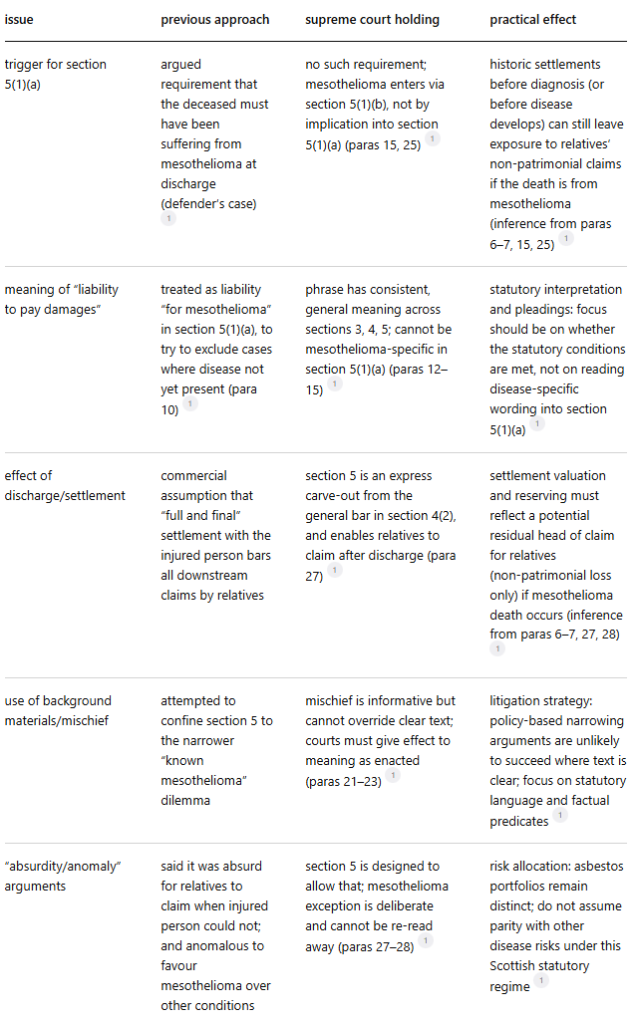
Comparative table (previous approach vs Supreme Court position).
Note: “previous approach” here means the defender’s argued construction and the practical assumption it supported; the Supreme Court confirms the correct reading for future cases and aligns with the courts below.
Practical implications for practice
Who is affected?
Directly, this is a Scottish wrongful‑death damages issue, so it matters most for defenders facing Scottish delict claims for asbestos exposure and for organisations whose historic workforce, estates, or projects involved asbestos. Practically, that includes utilities, heavy industry, construction and refurbishment supply chains, public‑estate owners and FM providers, transport/shipbuilding, and any group inheriting legacy liabilities in acquisitions or restructurings (inference drawn from the fact‑pattern and the statutory focus on asbestos‑related disease, including the interplay of asbestosis/pleural plaques and later mesothelioma).
The decision’s breadth/limits :
The holding is broad in reach because it covers discharges where mesothelioma is not present and might not even have developed at the time of settlement; the Court expressly recognised that the statutory drafting protects “a wider category” including those not yet diagnosed and those who develop mesothelioma later (para 25). But it is narrow in subject‑matter: it does not create a general “future fatal disease” exception; section 5 is an “exception for mesothelioma” and “does not create an exception for lung cancer or any other condition” (para 28).
Contract drafting impact is mostly about (a) settlement documentation in personal injury claims, and (b) risk allocation instruments that price asbestos exposure (insurance, intra‑group indemnities, SPA/W&I‑adjacent indemnity stacks). The critical practical implication is that a settlement with the injured person which discharges the defender’s liability will not necessarily extinguish the statutory head of claim for relatives’ non‑patrimonial loss where section 5 applies; section 5 is designed to allow relatives to claim even after discharge (para 27).
Suggested drafting notes
- Expressly recognise residual statutory exposure: “Nothing in this agreement is intended to exclude or limit any rights which cannot lawfully be excluded, including (where applicable) any rights of relatives under section 4(3)(b) as preserved by section 5 of the Damages (Scotland) Act 2011.”
- Evidence preservation clauses: require retention/availability of exposure and employment records relevant to causation/quantum; section 5 claims may be raised years after settlement (inference from the long latency implicit in the facts and the post-settlement death).
- Indemnity clarity in transactions: where purchasing/insuring legacy liabilities, define whether indemnities include wrongful-death relatives’ non-patrimonial claims arising notwithstanding historic settlements (inference from section 5 operating after discharge).
Litigation strategy
The decision narrows the available “silver bullet” defences based purely on the timing of settlement versus diagnosis. Post-Veale, defenders should expect the statutory question to be shorter and the battleground to move to the remaining elements: whether section 3’s preconditions are met, whether the death was from mesothelioma, whether the discharge condition and dates are satisfied, and then quantum under section 4(3)(b).
Precedent change
The practical “change” is the removal of residual ambiguity: any lingering hope that section 5 could be confined to known-mesothelioma-at-discharge cases has now been shut down, and future arguments will need to be framed around the statutory wording, not the narrower mischief narrative.
Next steps and risk management for legal practitioners
A proportionate response is to identify which settlements might have left a section 5 tail risk, and to build that into reserves, insurer notifications, and litigation playbooks (inference from the facts and the Court’s explanation that section 5 enables relatives to claim after discharge).
Checklist for legal practitioners:
- Identify Scottish asbestos/exposure cohorts and map historic settlements/discharges (including “risk of mesothelioma” settlements).
- Review settlement templates: add explicit wording recognising non-excludable statutory rights and documenting the scope of the discharge.
- Update reserving logic to reflect a potential section 4(3)(b) relatives’ claim tail in mesothelioma cases notwithstanding discharge.
- Strengthen document retention for exposure evidence and settlement packs; assume claims may re-emerge years later.
- For M&A/real-asset transactions, ensure asbestos due diligence and indemnities explicitly capture (or exclude, and price) this Scottish relatives’ non-patrimonial head of claim.
Legislative/apellate consequences
There is no further domestic appeal route from the Supreme Court. On potential legislative change, the judgment notes consideration of whether other conditions should attract a similar exception and records the conclusion that mesothelioma cases are “highly exceptional” and that there was “no need” at the time to extend the exception (para 28, including the reference to Scot Law Com No 213 (2008), paras 3.27–3.28).
Conclusion
Veale confirms a straightforward but high-impact proposition: under the Damages (Scotland) Act 2011, a pre-death discharge of liability to the injured person does not necessarily bar relatives’ non-patrimonial claims when the deceased later dies from mesothelioma; section 5 is drafted to preserve that narrow category of claim, and it does so even where mesothelioma was not present at the time of settlement. The appeal was dismissed (para 29).
Cite this work:
To cite this resource, please use the following reference:
National Case Law Archive, 'Veale v Scottish Power: mesothelioma settlements, statutory releases, and relatives’ claims after discharge' (LawCases.net, February 2026) <https://www.lawcases.net/analysis/veale-v-scottish-power-mesothelioma-settlements-statutory-releases-and-relatives-claims-after-discharge/> accessed 26 October 2026
Articles and content on this site are for informational purposes only and do not constitute legal advice. Do not rely solely on this information.
