Reviewed by Jennifer Wiss-Carline, Solicitor
If you believe a will does not reflect what the person who made it truly wanted, or that it leaves someone without the financial support they should have received, you may be able to challenge it. This is usually called “contesting a will”.
“Contesting a will” is a phrase people search for, but it covers several very different legal routes. This guide explains what those routes are, who can use them, how long you have, what it costs, and how the process works in England and Wales. It is the hub of our contested probate resource and links to detailed guides on each issue.
This guide covers the law of England and Wales only. The law in Scotland and Northern Ireland is different in important respects, including forced heirship rules in Scotland.
Short answer: can you contest a will?
You can contest a will, but only if three things are true:
- You have legal standing. You must be someone the law recognises as entitled to bring the type of claim you have in mind, such as a beneficiary under an earlier will, a family member, a dependant, or a person who was promised something.
- You have a recognised legal ground. Being upset, surprised or disappointed by a will is not, on its own, a reason a court will overturn it. You need a ground the law recognises, such as lack of capacity, undue influence, or a claim for reasonable financial provision.
- You have evidence. Courts decide these cases on documents and witnesses, not on suspicion. Medical records, the will-drafter’s file, attendance notes, earlier wills and witness statements usually matter more than family feeling.
If you think all three apply, you should speak to a contentious probate solicitor (will dispute solicitor) quickly. Time limits can be short, and some steps (such as entering a caveat) need to happen before probate is granted.
What does “contesting a will” actually mean?
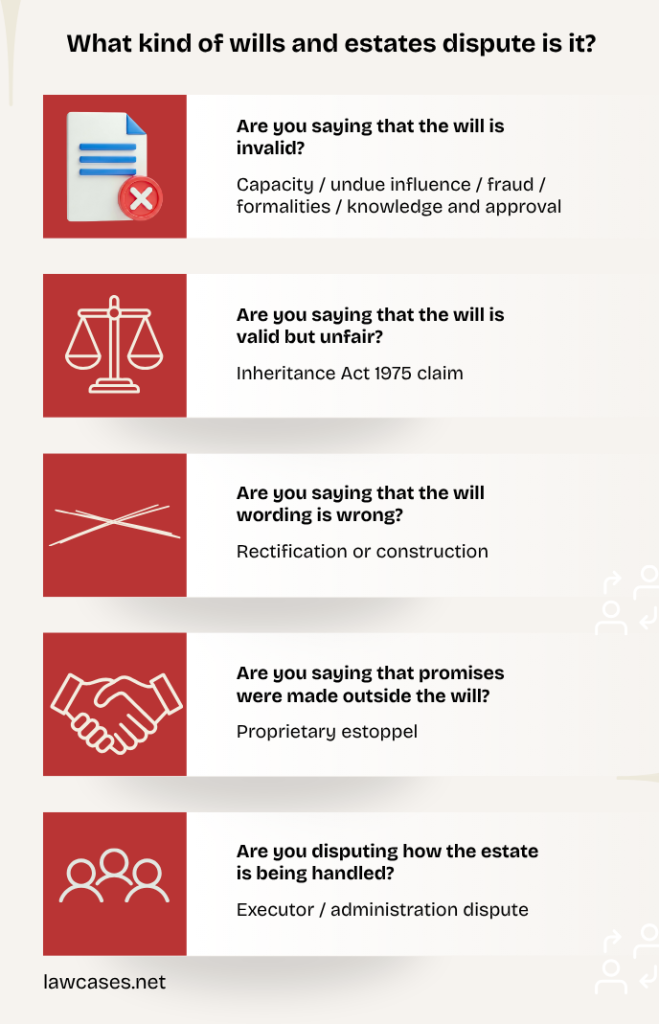
There are six main legal routes that people describe, loosely, as “contesting a will”. They have different tests, different time limits and different outcomes. Identifying the right route early is one of the most important things you can do.
1. Challenging the validity of the will
This is a claim that the will itself is not legally valid and should not be admitted to probate. If successful, the court sets the will aside. The estate is then distributed either under an earlier valid will or under the intestacy rules.
The recognised grounds are:
- lack of testamentary capacity;
- lack of knowledge and approval;
- undue influence;
- fraud or forgery;
- fraudulent calumny;
- failure to comply with the formalities in section 9 of the Wills Act 1837.
A point to note – sometimes the question is not whether a will is valid, but whether it is still the last will at all. A will can be revoked by a later will or codicil, by a written revocation, by destruction with the intention to revoke, or by the testator’s subsequent marriage or civil partnership. If the original will cannot be found after death and was last known to be in the testator’s possession, the court will normally presume it was destroyed with the intention of revoking it. These issues can end a dispute before the validity grounds are ever reached.
2. Claiming reasonable financial provision under the Inheritance Act 1975
This is not a challenge to the will itself. The will is accepted as valid, but the claimant argues that it (or the intestacy rules) failed to make reasonable financial provision for them. If successful, the court varies how the estate is distributed. Claims are brought under the Inheritance (Provision for Family and Dependants) Act 1975.
This route is often the right one for spouses, civil partners, children, cohabitants and financial dependants who have been left out or left too little.
3. Rectification or construction
Sometimes a will is valid but wrong. It may contain a clerical error, or it may be ambiguous. The court can correct it (rectification) or decide what it means (construction) under section 20 and section 21 of the Administration of Justice Act 1982.
4. Executor or administration disputes
Sometimes the will is not the problem – the executor is. Beneficiaries can challenge how an executor is dealing with the estate, ask the court to remove them, or require them to account.
5. Proprietary estoppel and broken promises
If the person who died made a clear promise that you would inherit something, you relied on that promise, and you suffered a detriment because of it (for example, by working on the family farm for low pay for years), you may have a claim in proprietary estoppel. This is technically a claim against the estate rather than a challenge to the will, but it is the right route for many “I was promised…” cases. You can read more about estoppel here.
The main grounds for contesting a will
Below is a short summary of each ground. For a more detailed look at the grounds for contesting a will, see our guide here.
Lack of testamentary capacity.
The person who made the will (the “testator”) must have understood what they were doing when they made it. The test comes from Banks v Goodfellow (1870) and is still used today. Dementia, delirium, serious illness, heavy medication and delusions can all affect capacity, but a diagnosis alone is never enough. Capacity is assessed at the time the will was made.
Lack of knowledge and approval.
Even a person with capacity must actually know and approve the contents of their will. This ground is often used where there are suspicious circumstances, such as the main beneficiary arranging or being present at the drafting.
Undue influence.
This is coercion that overpowers the testator’s own wishes. Pressure, persuasion and family tension are not enough; there must be coercion. The bar is high and the evidence is usually circumstantial. The Court of Appeal restated the high burden recently in Rea v Rea [2024] EWCA Civ 169.
Fraud and forgery.
A forged signature, a fabricated will, or a will procured by dishonest conduct can be set aside. These cases often turn on handwriting experts and documentary evidence.
Fraudulent calumny.
A narrower but distinct ground. It arises where someone poisons the testator’s mind against a natural beneficiary by making dishonest statements they know to be false or do not believe to be true.
Failure to comply with formalities.
Section 9 of the Wills Act 1837 requires a will to be in writing, signed by the testator (or by someone else at their direction in their presence), with the testator intending to give effect to the will, and witnessed by two people present at the same time who also sign. If any of these requirements is missing, the will is invalid.
Rectification and mistake.
A clerical error, or a failure by the drafter to understand the testator’s instructions, can be corrected under section 20 of the Administration of Justice Act 1982.
Inheritance Act 1975 claim.
A separate route for people who have not been reasonably provided for. This is not a validity challenge.
Who can contest a will?
Standing depends on the type of claim. As a general guide:
- Validity challenges can be brought by anyone with a financial interest in the outcome. That usually means beneficiaries under the disputed will, beneficiaries under an earlier will, or people who would inherit on intestacy if the will were set aside.
- Inheritance Act 1975 claims can only be brought by the categories listed in section 1 of the Act: spouses and civil partners, former spouses and civil partners who have not remarried, cohabitants of at least two years, children (including adult children), people treated as children of the family, and anyone who was being maintained by the deceased.
- Rectification and construction claims are typically brought by those affected by the error or ambiguity.
- Proprietary estoppel claims can be brought by anyone who received a clear promise, relied on it, and suffered detriment.
Stepchildren, siblings, friends and carers are often surprised to learn that they have no automatic right to contest a will. They may still have a claim, but usually only if they were financially maintained by the deceased or treated as a child of the family, or if they were promised something.
How long do you have?
Time limits are one of the most dangerous areas of contested probate. Missing a deadline can end a good claim. The main limits are:
| Type of claim | Time limit |
|---|---|
| Inheritance Act 1975 claim | Six months from the grant of representation (section 4 of the 1975 Act). The court can extend time but will not do so lightly. |
| Rectification under the Administration of Justice Act 1982 | Six months from the grant of representation, subject to the court’s permission to bring it later. |
| Validity challenge before probate | No fixed statutory limitation period, but you should act before the grant is issued. A caveat must be entered before probate is granted; it lasts six months initially and can be extended. |
| Validity challenge after probate | No fixed statutory limitation period, but delay can seriously damage or defeat a claim. A probate claim under CPR Part 57 may seek revocation of a grant or a decision on validity, and delay may create practical and equitable obstacles, especially once evidence is lost or the estate has been distributed. |
| Fraud | No single deadline. Under section 32 of the Limitation Act 1980, time may not start running until fraud, deliberate concealment or mistake is discovered (or could reasonably have been discovered). Under section 21, there is no limitation period for certain beneficiary claims involving fraud, fraudulent breach of trust, or recovery of trust property. Delay can still damage a claim. |
| Claim against an estate as a creditor | Generally 12 years for a beneficiary’s claim to recover estate assets, and six years for interest, under the Limitation Act 1980, but this is fact-sensitive. |
A word of caution. Please treat the deadlines above as a general guide only. Time limits in contested probate are fact-sensitive, and the claim you think you have may not be the strongest claim available to you on the facts. If you believe you may have grounds to contest a will or bring a claim against an estate, speak to a will disputes solicitor as early as possible – ideally before probate is granted.
Probate claims are governed by Part 57 of the Civil Procedure Rules and Practice Direction 57.
How to contest a will: the basic process
Every case is different, but a typical contested probate matter moves through these stages.
- Get the will and establish the probate position. Ask the executors for a copy of the will. If probate has been granted, you can obtain the will and grant from the Probate Registry through the GOV.UK search service.
- Work out what kind of claim you may have. Is this a validity challenge, a 1975 Act claim, a rectification issue, a dispute with executors, or a broken promise?
- Consider a caveat or standing search. If probate has not been granted and you want to challenge validity, a caveat prevents a grant being issued without notice to you.
- Gather evidence. Medical records, the testator’s GP notes, care home records, previous wills, the solicitor’s file, bank and financial records, messages, photographs and witness accounts can all matter.
- Send a Larke v Nugus request. If the will was prepared by a solicitor, you (or your solicitor) can ask the drafter for a full account of the circumstances in which the will was made and a copy of their file. This is the standard practitioner route established in Larke v Nugus.
- Send a letter of claim. This sets out the basis of your claim, the evidence, and what you want.
- Try to settle. Most contested probate claims settle. Mediation is now almost standard and is strongly encouraged by the courts.
- Issue proceedings only where necessary. Probate claims are issued under CPR Part 57. Trials in this area are expensive, long and emotionally draining.
Caveats: a warning
A caveat is a formal notice lodged at the Probate Registry that prevents a grant of probate being issued for six months (renewable). It is a powerful but serious tool.
GOV.UK describes a caveat as a way to challenge another person’s probate application where there is a genuine dispute, such as a question about who should apply, whether a will exists, or whether the will is legal.
A caveat should not be used casually or tactically. If the executor “warns off” the caveat and you enter an appearance without a proper basis, you risk adverse costs. Take advice before entering one.
Costs and risks
Contested probate can be expensive. Honest websites do not give you a single figure, because costs depend on the ground, the evidence, the opponent and how early the matter settles. Many cases settle at or before mediation for a fraction of the costs of trial. Others, particularly capacity and undue influence disputes with multiple witnesses and expert evidence, can run into six figures on each side.
The main cost drivers are:
- the ground of challenge (capacity and undue influence usually need expert medical and factual evidence);
- the size and complexity of the estate;
- the number of parties;
- whether the other side engages constructively or not;
- whether the case settles at mediation or runs to trial.
The default rule in English litigation is that costs follow the event: the loser pays a proportion of the winner’s costs. The old idea that “costs always come out of the estate” is largely a myth in modern contested probate. The court will only order costs from the estate in limited circumstances, usually where the testator or those interested in the residue effectively caused the litigation, or where there were genuine grounds to investigate the will.
Funding options include:
- paying privately;
- conditional fee agreements (no win, no fee);
- damages-based agreements;
- deferred fee arrangements;
- legal expenses insurance on a home policy;
- after-the-event (ATE) insurance to protect against adverse costs.
Evidence needed
Evidence wins contested probate cases. The most important categories are:
- the will itself and any earlier wills or drafts;
- the will-drafter’s file, attendance notes and instructions, and any record of the solicitor’s own assessment of capacity (obtained through a Larke v Nugus request);
- and any contemporaneous medical capacity assessment if one was obtained;
- the testator’s GP records, hospital records and care home records;
- witness statements from family, friends, carers, neighbours and professionals;
- financial records, bank statements and gifts made before death;
- messages, emails, letters and photographs;
- handwriting expert evidence in forgery cases;
- evidence of financial dependency in 1975 Act claims.
Not all of the above items are needed in every case – some may not be relevant.
What happens if the challenge succeeds?
The outcome depends on the route taken.
- A successful validity challenge sets the will aside. The estate is then distributed under the most recent earlier valid will, or under the intestacy rules if there is none.
- A successful 1975 Act claim does not set the will aside. The court makes an order varying the distribution of the estate to provide for the claimant. The order can take the form of a lump sum, periodical payments, a transfer of property or a life interest.
- Successful rectification amends the wording of the will to reflect the testator’s true intentions.
- A successful proprietary estoppel claim results in a remedy based on the promise and the detriment suffered. That can be the promised asset, a share of it, or a money award. The Supreme Court revisited the remedy question in Guest v Guest [2022] UKSC 27.
- A successful executor challenge may lead to the removal and replacement of the executor or an order requiring them to account.
Do I need a solicitor to contest a Will?
For anything beyond an initial enquiry, yes. Contested probate is not a safe DIY area. The time limits are unforgiving, the procedural rules in CPR Part 57 are technical, caveats carry costs risk, pleadings in probate claims are drafted to a particular standard, and the evidence required (medical records, solicitor files, expert reports) is difficult to obtain and assess without experience.
A good will dispute solicitor can also tell you, honestly and early, whether your claim is worth pursuing. That advice alone often saves the most money.
Preventing and defending challenges
Not every visitor to this page is thinking about bringing a claim. Some are trying to make a will that is hard to challenge; others are executors or beneficiaries defending a will that is under attack.
You cannot guarantee that nobody will challenge a will, but you can make a challenge much harder by taking proper instructions, using a solicitor, obtaining capacity evidence where appropriate (the “golden rule”), keeping thorough attendance notes, explaining unusual decisions in a letter of wishes, and ensuring execution is witnessed correctly.
If you are defending a will, the priorities are to preserve evidence, respond properly to any Larke v Nugus request, keep a neutral executor stance where possible, and engage with mediation.
Important cases
Contested probate is a common-law area and turns heavily on decided cases. Some of the authorities every contested probate lawyer should know are:
- Banks v Goodfellow (1870) LR 5 QB 549 – the foundational test for testamentary capacity.
- Wingrove v Wingrove (1885) 11 PD 81 – coercion, not mere persuasion, is required for undue influence.
- Gill v Woodall [2010] EWCA Civ 1430 – a leading modern case on knowledge and approval.
- Marley v Rawlings [2014] UKSC 2 – the Supreme Court’s decision on rectification where spouses signed each other’s wills.
- Ilott v The Blue Cross [2017] UKSC 17 – the leading modern authority on adult child 1975 Act claims.
- Guest v Guest [2022] UKSC 27 – the Supreme Court on the correct remedy in proprietary estoppel.
- Rea v Rea [2024] EWCA Civ 169 – the Court of Appeal restating the high burden for undue influence.
Future reform
In May 2025 the Law Commission published its final report Modernising Wills Law, with recommendations on capacity, undue influence, electronic wills and formalities. Those recommendations are not the current law unless and until they are implemented. We cover them on a separate page and flag where they may affect the law in future.
Which route is right for you?
The single most useful question to ask at the outset is:
Do you think the will is wrong because the testator could not properly make it (or did not really make it), or because the will is valid but unfair to you?
- If the first, you are looking at a validity challenge.
- If the second, you are usually looking at a 1975 Act claim, or a proprietary estoppel claim if there was a specific promise.
Getting that distinction right at the start will save you time, money and stress. The rest of this hub is designed to help you work out which route fits your situation, and what to do next.

