

The Supreme Court’s decision in R (Jwanczuk) v Secretary of State for Work and Pensions is a two‑track judgment with significance well beyond bereavement benefits. First, it is a firm restatement of judicial restraint in the welfare sphere: even where the claimant establishes disability‑related Thlimmenos discrimination within the ambit of A1P1, the court may still accord Parliament a wide margin and uphold a bright‑line eligibility rule if the court is satisfied the scheme strikes a fair balance.
Secondly, it is an important constitutional and practical corrective on precedent in a devolved UK: the strict “follow unless compelling reason” approach derived from revenue authorities is not a general rule for UK‑wide (or identical) statutes outside taxation. The Supreme Court’s message is simple and operational: cross‑jurisdiction decisions deserve great respect, but they are persuasive, not quasi‑binding; if you think the other court is wrong, say so and facilitate an appeal.
Outcome-wise, the appeal was unanimously allowed. A surviving spouse in the respondent’s position is not entitled to bereavement support payment (“BSP”) where no actual NI contributions were paid by the deceased spouse, even if the reason for non‑contribution was lifelong severe disability.
For solicitors, the practical consequences are immediate: (i) BSP advice must start (and often end) with a hard eligibility check against the statutory contribution condition and the narrow work‑death exception; (ii) welfare discrimination challenges must be pleaded and evidenced with the justification stage front‑of‑mind; and (iii) when running UK‑wide statutory points, you cannot outsource analysis to an appellate decision from another jurisdiction and treat it as effectively determinative (either as claimant or defendant).
Factual background and procedural route
The respondent, Daniel Richard Jwanczuk, claimed BSP after the death of his wife Suzanne Jwanczuk in November 2020. She had a progressive congenital muscular dystrophy and had never been in employment or self‑employment; accordingly, she had not “actually paid” relevant Class 1 or Class 2 national insurance contributions during her working life. The claim was refused and that refusal was maintained on reconsideration.
He sought judicial review, arguing that refusing BSP in these circumstances breached article 14 ECHR read with A1P1 (the claim proceeded on A1P1; article 8 did not ultimately matter). The claim succeeded in the High Court and again in the Court of Appeal, both courts treating themselves as practically bound to follow a Northern Irish appellate decision on materially identical statutory wording.
Central to the lower courts’ approach was O’Donnell in the Northern Ireland Court of Appeal, which had held the contribution condition discriminatory in disability‑related “associative” terms and had used section 3 HRA to treat the condition as met where the deceased was unable to work throughout their working life due to disability. Northern Irish authorities then issued operational guidance to decision‑makers to implement that approach in practice.
The appeal to the Supreme Court of the United Kingdom therefore raised (i) the cross‑jurisdiction precedent question and (ii) whether the contribution condition – properly analysed – unlawfully discriminates in the respondent’s circumstances, and if so, what remedy could follow.
Legal issues before the court
The Supreme Court framed the case as raising two main issues: a “substantive” welfare/HRA issue and an “important constitutional question” about how the senior courts in one UK jurisdiction should treat decisions from another jurisdiction where the statutory language is the same or materially identical.
On the HRA/ECHR side, the dispute broke down into familiar steps (as the judgment itself does): whether the claim fell within the ambit of A1P1; whether the respondent had a relevant “status” (including “other status” and associative disability-related status); whether there was Thlimmenos discrimination; and, critically, whether any discriminatory effect was objectively and reasonably justified – including the appropriate intensity of review in a welfare scheme enacted in primary legislation.
There was also a remedy issue: whether, if the legislation were incompatible, the court could “read in” an exception under section 3 HRA or whether any proper remedy would lie (if at all) in a section 4 declaration. In the event, the Supreme Court treated remedy as academic (because it upheld compatibility), but it still gave a clear view on section 3’s limits in this context.
The court sat as Lord Reed and Lady Simler giving a joint judgment, with agreement from Lord Lloyd-Jones, Lady Rose, and Lord Richards. There was no dissent.
How the court reasoned
The cross-jurisdiction “precedent” point: persuasive authority, not quasi‑binding
The Supreme Court was explicit that the relationship between appellate decisions across UK jurisdictions is not governed by the doctrine of precedent, but by practice. In the court’s words: “The question is governed by practice, not law” (para 92).
The judgment explains why a strict “follow unless compelling reason” approach has deep roots in tax (constitutional/economic importance of uniformity, contractual and investment reliance, and coherence of taxation across the state), but rejects the assumption that this strict approach can simply be exported into other fields (including social security, employment, and Convention rights litigation).
The operational guidance for future appellate practice is contained in para 101, which practitioners should treat as a quotable practice proposition: “appellate courts should not regard themselves as being under an obligation to follow decisions which they consider to be wrong” (para 101).
The court went further: it rejected the idea that a court must find “exceptional circumstances” or an additional “compelling reason” beyond identified error. Where the later appellate court concludes a cross‑jurisdiction decision is wrong, the better course is to explain why, decide the point, and enable an appeal to the Supreme Court so the divergence is resolved without undue delay.
Two features of devolution were particularly emphasised as reasons not to assume strict uniformity: (i) similarly worded legislation may reflect different legislative and executive choices in different parts of the UK, and (ii) the party configuration may differ (as here, where the Northern Irish proceedings concerned devolved legislation and the UK Secretary of State was not a party), which reduces the fairness of treating the earlier decision as something approaching binding effect.
The article 14 analysis: status accepted, discrimination assumed, justification dispositive
On the discrimination claim, the Supreme Court accepted that BSP refusals fall within the ambit of A1P1 and proceeded on that basis. It also declined to spend time on article 8 because it would add nothing to the analysis.
Crucially for future pleadings, the court accepted that a claimant can have a relevant article 14 “other status” defined by associative disability-related characteristics of the deceased partner: it rejected objections that the status was too subjective or too indeterminate, and treated evidential/administrative difficulty more as a justification question than a threshold “status” bar.
Having accepted status, the judgment treated the case as a classic Thlimmenos complaint: the respondent was treated the same as widowers whose spouses paid no contributions for reasons other than lifelong disability-related inability to work, and the question therefore became whether the failure to create an exception from the contribution condition is justified.
Justification was approached through proportionality (including the “Bank Mellat questions”), but with strong emphasis – drawn from the court’s own more recent welfare jurisprudence – that there is no mechanical formula: intensity of review depends on context, suspect grounds, consensus, and a range of case‑specific features.
Why the court upheld the contribution condition
The Supreme Court accepted the Secretary of State’s three central aims: (i) advancing the contributory principle by rewarding and encouraging work and reducing stigma; (ii) maintaining a simple and workable bright‑line system with low administrative burden and swift processing for bereaved claimants; and (iii) providing clarity and certainty for planning.
The respondent’s case sought to narrow the margin by pointing to disability as a “suspect ground” and to the modesty of the contribution level (the judgment notes that the contribution condition is modest and could in practice be met by relatively limited work at some point in a lifetime). But the court’s answer was twofold.
First, it treated the link between disability and disentitlement as less direct than cases where a measure is based on disability itself. The court did not understate the vulnerability of people in the deceased’s position, but it considered the connection “relatively weak” and did not accept that the BSP rule perpetuates disability stereotypes or impedes labour-market participation by disabled people.
Second, it treated Parliament’s legislative history as significant: the contribution condition was introduced following consultation in which the impact on those unable to work due to illness or disability was expressly raised, yet the policy decision was to maintain eligibility based on actual contributions and to exclude NI credits and voluntary Class 3 contributions. This was not inadvertence: the court treated it as a conscious political and legislative choice in a resource‑allocation domain.
The judgment also gave real weight to bright‑line rules as a legitimate design feature of welfare systems, including the proposition—useful for both claimant and defendant advising—that legislative line‑drawing can be justified even though hard cases will fall on the wrong side. In the court’s words: “Parliament is entitled to legislate in a general way in relation to welfare benefits and is entitled to draw a bright line” (para 146).
In the BSP context, the court accepted that there is no obvious alternative bright‑line proxy for “lifelong inability to work”, and that an exception would introduce retrospective, individualised, evidence‑heavy determinations at a sensitive moment for claimants—precisely what the simplified scheme was intended to avoid.
In the end, the court located the proportionality balance in institutional competence and democratic legitimacy: many welfare‑fairness questions “cannot be answered by any process of legal reasoning” because they lack legal standards of calibration, and elected institutions are better placed to strike the affordability/fairness balance.
Remedy: a clear warning on section 3 “reading in”
Although academic, the remedy section contains an important practice lesson. The court indicated it would not have been “possible” under section 3 HRA to read an incapacity exception into the contribution condition in primary legislation, because such an exception would not “go with the grain” of the scheme: Parliament had made a single narrow exception (the “death at work” exception) and had deliberately maintained the requirement for actual paid contributions.
Accordingly, if incompatibility were ever established for primary legislation of this kind, solicitors should assume that the remedial battle will usually be about (i) whether to seek a declaration and (ii) how to manage the client’s expectations and timing in the inevitable period between declaration and legislative response—rather than assuming section 3 can be used to engineer a bespoke eligibility carve‑out.
Practice implications for solicitors/legal practitioners
Litigation implications: pleading, evidence, and forum strategy
This judgment reshapes “how to run” welfare discrimination litigation at three points in the pipeline.
At the threshold, claimants may take some comfort from the court’s acceptance of an “other status” defined by associative disability-related characteristics, and from its recognition that evaluative determinations can be “objective” if they are rational evaluations of established facts. That said, the practical consequence is not claimant‑friendly overall, because the court effectively relocates many claimant arguments from threshold to justification – where the margin may remain wide.
At justification, the judgment reinforces the need to treat proportionality as the real battleground. The court endorsed a flexible approach to intensity of review: “manifestly without reasonable foundation” is not a talisman, and even where disability is in play, other factors (primary legislation, resource allocation, recent consultation and conscious policy choice, absence of consensus) can widen the margin. Pleadings and evidence must therefore address (not merely assert) why this case is one where the court should narrow the margin and why less intrusive design options were realistically available.
On evidence and disclosure, the judgment contains a quiet but important steer: internal exchanges between Ministers and civil servants may be “useful background” but are “of no assistance” to determining legislative intention and are not a legitimate tool of statutory construction. For public law litigators, that signals caution about investing heavily in disclosure battles aimed at “debunking” internal policy assumptions when the statutory scheme has been publicly consulted on and enacted in primary legislation.
Finally, on forum and precedent strategy, the comity section affects both claimant and defendant tactics whenever UK‑wide or identical devolved statutes are in issue. You can rely on cross-jurisdiction appellate decisions as persuasive authority, but you must still do the work: expect the court to engage with merits and be prepared to invite (or resist) a departure without the rhetorical crutch of “exceptional circumstances”. This has real consequences for: intervention strategy; whether to rush a case to create a “test” vehicle; and whether to settle pending authoritative resolution.
Transactional and advisory implications: client guidance in plain terms
Although the case is rooted in social security, it has a broader advisory echo for private client, family, employment and regulatory practices that sit adjacent to state benefits.
For private client and family solicitors, ensure client advice does not assume BSP is a dependable component of bereavement cashflow. On the Supreme Court’s analysis, BSP is a short‑term contributory benefit tied to the deceased’s paid contributions (with a narrow statutory exception), and there is a separate non‑contributory safety net. In practice, advice should reflect that families of those who cannot ever work may need to plan around alternative income sources rather than expecting BSP to be “read down” by the courts.
For employment and workplace benefits advisers (especially for employers with enhanced death‑in‑service arrangements), the key practical takeaway is risk‑framing: state BSP is not “disability‑sensitive” by judicial implication, and employers should not assume the state will fill short‑term bereavement gaps for dependants of those with lifelong inability to contribute. This is not a direct employment law holding, but it is a real-world counselling point in benefit communications and wider employee wellbeing advice.
For public bodies and those contracting with them, the cross‑jurisdiction precedent guidance matters when statutory schemes apply across United Kingdom or across Great Britain: legal risk registers and advice notes should not treat a Scottish or Northern Irish appellate judgment as a de facto “UK position”, except in the narrow areas where practice has hardened (notably tax). That matters for certainty, programme design, and litigation provisioning.
Comparing practice pre‑ and post‑judgment
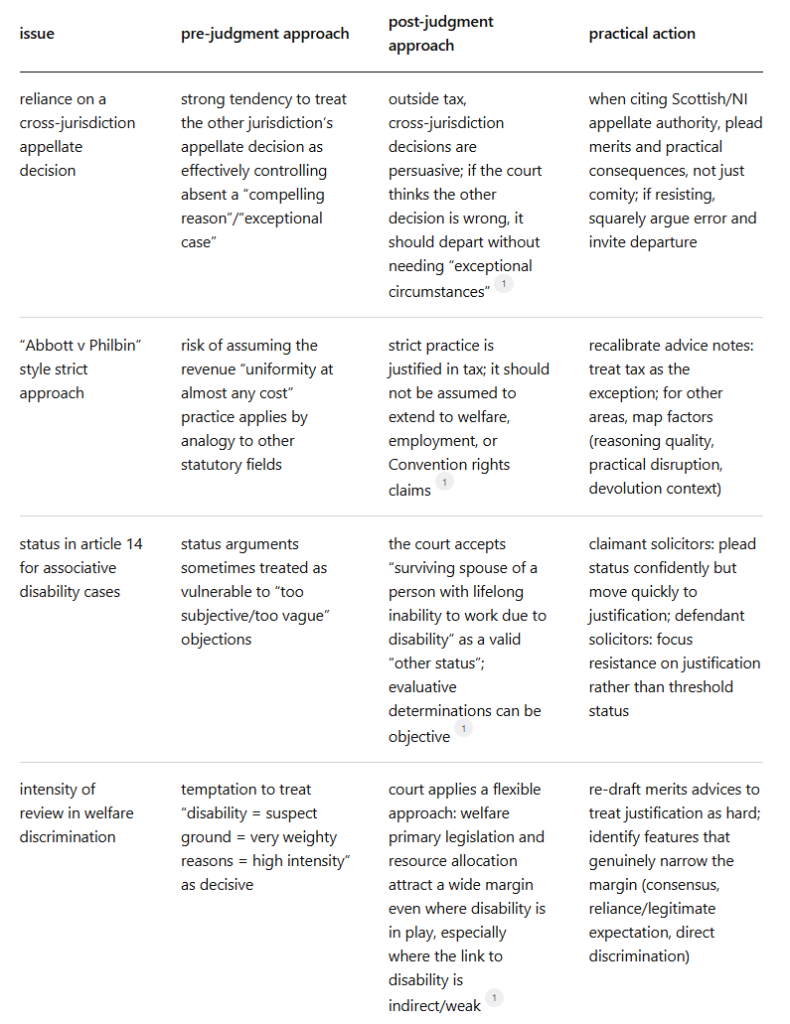
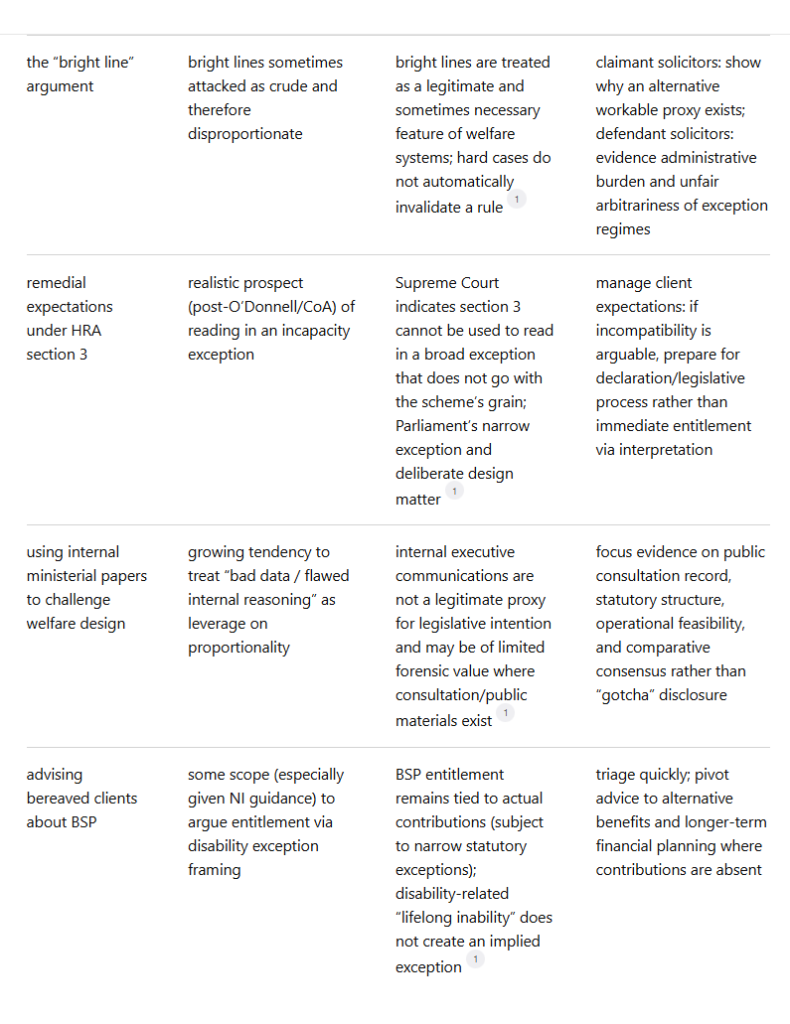
Recommended actions for legal practitioners
Front‑end client triage (all practices): stepwise checklist
- Identify whether the claim is BSP (not a different bereavement benefit) and confirm which statutory scheme applies (particularly if the client is connected with Northern Ireland or has cross‑border work history).
- Obtain (or help the client obtain) the deceased’s NI contribution record and confirm whether there is any tax year with actual Class 1/Class 2 contributions at the statutory level; remember the Court’s observation that the threshold is “modest”, but actual payment remains fundamental.
- If there were no paid contributions, check the narrow statutory exception tied to work‑related death; do not assume “credits” or voluntary contributions can substitute where the scheme requires “actually paid” contributions.
- Where BSP is unavailable, shift promptly to alternative support routes (the judgment repeatedly distinguishes BSP’s purpose from income‑replacement support and notes the existence of other benefits).
Litigation and public law teams: how to re‑tool discrimination challenges
- Treat status as necessary but rarely sufficient: the court accepted associative disability‑related status here, but nevertheless upheld the scheme on justification. Build the case around why the margin should be narrowed, not just why the claimant is sympathetic.
- Evidence must engage with: bright‑line workability, feasibility of alternative proxies, administrative burden, and demonstrable indicia of consensus or evolving standards. The court was receptive to evidence and reasoning on administrative feasibility and legislative design.
- On remedy, plan for the section 3/section 4 boundary early. If the challenge necessarily requires creation of a wide new exception, assume the court will treat that as “going against the grain”, making a declaration the more realistic route if incompatibility is ever made out.
- If you rely on cross‑jurisdiction authority, cite it as persuasive – then do the substantive analysis. If you are resisting it, do not be shy about arguing it is wrong: the Supreme Court expressly removed the “exceptional circumstances” rhetorical hurdle outside tax.
Transactional and advisory teams: what to change in templates and client comms
- Update bereavement planning notes: treat BSP as contribution‑dependent and exclude any “automatic disability carve‑out” language.
- If you advise charities, unions, or employers supporting carers and disabled people, review standard advice sheets: the existence of devolved administrative guidance in some jurisdictions is not a safe basis to represent entitlement as a UK‑wide position post‑judgment.
- For clients with long‑term severe disability who are unlikely ever to pay contributions, treat this judgment as a prompt to check how far private arrangements (insurance, pension nominations, death‑in‑service) are expected to play a substitutive role for state short‑term payments. The court’s reasoning repeatedly situates BSP within a “contributory insurance” logic rather than general welfare support.
What comes next
Likely future developments
The judgment repeatedly signals that, in this domain, the “right” answer is one for Parliament: the court held that the proportionality balance turns on political judgement about allocation of scarce resources and the contributory principle, and that courts should be slow to substitute their own view. That is a strong indicator that any reform path—if there is one—will be legislative rather than jurisprudential.
Because the litigation history includes diverging Northern Irish practice (guidance treating the contribution condition as “met” in certain lifelong incapacity cases), one obvious practical consequence is that devolved administrators and advisers may need to revisit guidance and decision‑making approaches so they are aligned with the Supreme Court’s compatibility analysis (or consciously depart by legislative choice). The judgment itself highlights that the UK Secretary of State did not adopt the Northern Irish approach as a matter of policy, which will sharpen the political, rather than legal, character of any next step.
Unresolved questions for future cases
The court’s reasoning leaves some deliberate “space” that litigators should recognise.
One unresolved boundary question is how courts will characterise the strength of the connection between a suspect ground (such as disability) and the impugned treatment when the discrimination is associative and operates through a contributory eligibility rule. Here the court described the connection as relatively weak, which mattered to intensity of review; future cases may test what facts or scheme design features make that link stronger and so narrow the margin.
A second open area concerns the limits of bright‑line justification. The court accepted bright‑line welfare design as legitimate where alternative proxies are not workable; future challenges will likely focus on showing that workable proxies do exist (for example, via routinely held administrative data), thereby eroding the “no alternative bright line” pillar that helped justify this scheme.
Thirdly, the comity section invites further development in practice about when the “respect” owed becomes particularly weighty outside tax: the court identified factors (convincing reasoning; practical disruption; devolution context; nature of the statutory task), but it also stresses that this is judgement, not a rigid test—a fertile area for argument in UK‑wide statutory litigation.
Finally, on remedy, although section 3 was addressed only academically, the judgment is a strong signal that “reading in” broad new eligibility exceptions to primary welfare legislation will continue to be treated as going against the grain. For advisers, the unresolved practical question is timing and relief management: how to protect clients during the delay between a potential declaration and legislative change in other, future schemes where incompatibility might still be established.
Cite this work:
To cite this resource, please use the following reference:
National Case Law Archive, 'Jwanczuk: bereavement support payment and disability-related discrimination' (LawCases.net, November 2025) <https://www.lawcases.net/analysis/jwanczuk-bereavement-support-payment-and-disability-related-discrimination/> accessed 3 April 2026
Articles and content on this site are for informational purposes only and do not constitute legal advice. Do not rely solely on this information.

